By Jae-Ha Kim
Substack
May 28, 2026
☆☆☆½ (out of ☆☆☆☆)
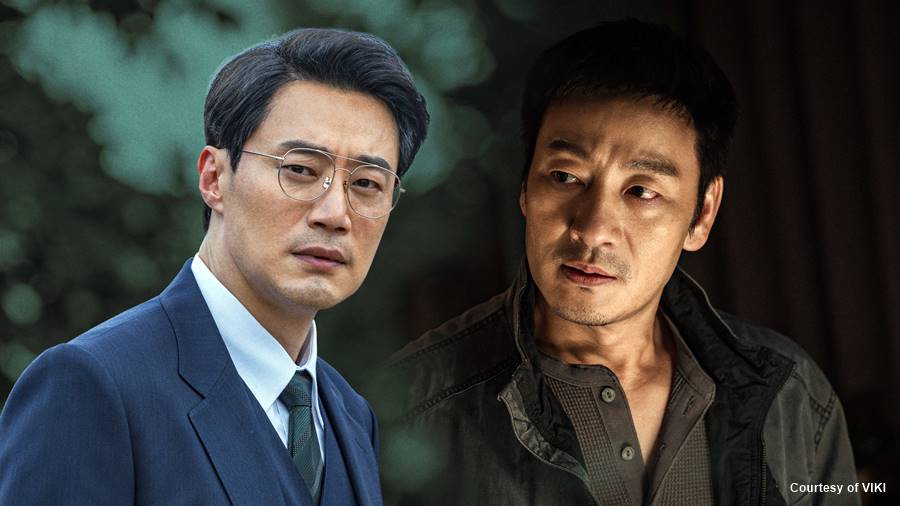
Kang Tae-joo (played by Park Hae-soo)
Cha Si-young (played by Lee Hee-joon)
Seo Ji-won (played by Kwak Sun-young)
↑Note: Korean names denote the surname followed by the given name.
Some people mistakenly describe K-dramas (even the best K-dramas) as soap operas. While daytime shows certainly exist in Korea—typically airing Monday through Friday for about 50 to 200+ episodes—the K-drama umbrella covers a multitude of genres. There’s crime (Signal), fantasy (Alchemy of Souls), medical (Hospital Playlist), slice of life (Our Blues), time travel (Lovely Runner), reincarnation (See You in My 19th Life), legal (Extraordinary Attorney Woo), historical sageuk (Moon Embracing the Sun), zombies (Kingdom), horror (Strangers From Hell) and more.
This year has already been a strong one for K-dramas, with top stars like Squid Game’s Park Hae-soo and Mr. Sunshine’s Yoo Yeon-seok starring in two of 2026’s best shows. It has also been a year where Kim Mu-yeol and Heo Nam-jun became international stars, thanks to their latest shows.

Based on the real-life Hwaseong Serial Killer who brutally murdered 15 South Korean girls and women from 1986-1994, The Scarecrow covers much of the same ground as Bong Joon-ho’s 2003 film Memories of Murder. But this K-drama more than holds its own, adding fictional twists to keep viewers engaged and guessing. Park Hae-soo (Squid Game) portrays Kang Tae-joo, an ace Seoul detective who is demoted back to his rural hometown of Gangseong. He’s a hot head, but he’s honest and by-the-book. When he’s reunited with his high school frenemy Cha Si-young (Lee Hee-joon), who is now a powerful prosecutor, Tae-joo wants nothing to do with him. They have a complicated past based on jealousy, lies, and social hierarchy. Si-young cares less about finding the real culprit than utilizing state-sanctioned force to create one.
In arguably the most powerful scene of the K-drama, director Park Joon-woo depicts a chilling juxtaposition of the killer beating and strangling a woman, while the police torture an innocent man into making a false confession. Which is worse—the deranged serial killer, or the brutal system that allows the empowered to make criminals out of victims? The Scarecrow doesn’t offer a pat answer. Rather, it makes viewers think about how easily we allow ourselves to be manipulated when we pretend it’s all for the greater good. (Viki)
___________________________________
Below the trailer, I’m going to share some additional thoughts about the relevance of generational names, as well as some key spoilers that I couldn’t fit into my Teen Vogue review.
NOTE: Do not read the spoilers below if you don’t want to know who the serial killer is!
Airdates: Twelve hour-long episodes aired on ENA from April 20 through May 26, 2026. (I watched this on Viki.)
Spoiler Alert:
Tae-joo’s younger sister Sun-young (played by Seo Ji-hye) and Ki-beom (Song Geon-hee) were engaged to be married. But under immense public pressure to catch the serial killer, Si-young sets up Ki-beom take the fall. Due to the severe beatings he endured while in police custody, Ki-beom dies before his baby is born.
The actual serial killer was Ki-beom’s older brother Ki-hwan (played by Jung Moon-sung).
Si-young had always been paranoid that Tae-joo was the illegimate son of his philandering father. In reality, it’s Sun-young.
In Episode 10, she reconciles herself with the fact that she will be moving into her birth father’s home, not because she loves him, but because his power will protect her baby. Trying to convince herself that she is making the right choice, Sun-young tells her brother, “It feels reassuring. What if the child gets judged for not having a father? What if they get rejected at school for being the child of a single mother?”
Although Tae-joo told her to stop worrying, and reassured her that he will be a strong male role model in his nephew’s life, Sun-young moves into her father’s home. She knows that Si-young ultimately was responsible for her fiancé’s death, but she takes their family surname, Cha, for the sake of her baby.
Near the end of the series, we see her grown up son Cha Young-beom (who is played by Song Geon-hee, the same actor who played his father). He is a journalist who is intent on finding out more about his lineage.
The significance of names:
Early in the series, there was a hint that Tae-joo and Si-young weren’t related, but that Si-young and Sun-young were. Though Sun-young was born out of wedlock, her father wanted her to have the same generational first name as her half brother, Si-young.
In Korea, first names can be generational markers.1 Most given names are comprised of two characters. For families who choose to do this, all the siblings (and sometimes cousins on the paternal side) will share either the first or second part of their first names.
• Sharing the 1st part of a given name: Kim Seok-jin of BTS and his elder brother Kim Seok-joong, share generational first syllables.
• Sharing the 2nd part of a given name: Korean superstar Lee Hyo-ri and her sisters Lee Ae-ri and Lee Yu-ri share the second syllable of their first names.
• Unrelated given names: But other Korean parents choose not to do generational names. (e.g. BTS’ Jung Ho-seok and his sister Jung Ji-woo.) And in this series, Tae-joo and Sun-young are half siblings who grew up together, but they didn’t share a generational name.
I’m wondering if any of you caught on to Si-young and Sun-young’s lineage prior to it being revealed in the series. Let me know in the comments below.
1 Korean first names are usually two syllables. For generational given names, one of the two syllables will be the same for all the children on the paternal side. i.e. Siblings and first cousins will share either the first or second syllable on their first name. Please note that this is traditional naming, and not all Koreans (especially today) continue to do this.
© 2026 JAE-HA KIM | All Rights Reserved
2 thoughts on ““The Scarecrow” (허수아비)”
Comments are closed.