BTS Shun the Grammys
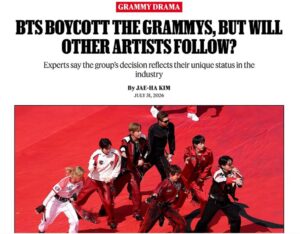
In my latest for Rolling Stone, I report on BTS removing themselves from Grammy contention in 2027, and what all of this means.
Journalist, Author & Syndicated Columnist
In my latest for Rolling Stone, I report on BTS removing themselves from Grammy contention in 2027, and what all of this means.

NPR’s Ayesha Rascoe speaks to syndicated columnist Jae-Ha Kim about the scandal that led to the death of beloved South Korean actor Lee Sun-Kyun. Note: This conversation has mentions of self-harm.
I was the first guest of 2024 on Phil Yu and Jeff Yang’s podcast, “They Call Us Bruce.” We discussed K-dramas, BTS, Lee Sun-kyun’s tragic death and how annoying it is when non-Asian members of the media co-opt our stories.

For many Westerners, Korean cinema didn’t enter their consciousness until the unparalleled success of the film “Parasite: in 2019. The gripping film deals with socio-economic discrepancies specific to modern-day South Korea, but the clever and sometimes brutal storyline hit a nerve with filmgoers worldwide. The film won the Palme d’Or at the Cannes Film Festival, an Oscar for Best Picture at the Academy Awards, and a BAFTA for Best Film Not in the English Language at the British Academy of Film and Television Arts.

Ayesha Rascoe speaks with journalist Jae-Ha Kim about the popularity of Korean television dramas on streaming services and her top recommendations.

May is Asian American and Pacific Islander Heritage Month. Coincidentally, it’s also Mental Health Awareness Month. And while the latter designation draws attention to the benefits of taking care of our overall well being, mental health care traditionally has been overlooked by Asians – a mindset that experts say has trickled down to Asian Americans.

“Having diverse characters leads to endless possibilities for storytelling. And there are infinite ways to tell an adoptee’s story…”

NPR asked me to share my thoughts about the Korean series, “Squid Game,” for their Pop Culture Happy Hour podcast. We discussed the controversy about the subtitles, whether the Western actors in Episodes 7 lended anything to the series and whether a Season 2 would be a good thing or not.

MTV News interviewed me for this piece on how differently “Parasite” director Bong Joon-Ho and BTS are viewed by critics.

Individual responsibility isn’t enough. There needs to be social change: “The audience, media and culture need to shift into acceptance rather than demanding Korean artists conform
to meet our expectation. Otherwise, these stars are caught in a loop of abuse that will never end.”

Recognizing these cultural differences and relating to even the most unrelatable stories are all part of what makes watching Korean dramas so satisfying. Where else can you experience second lead syndrome (where you’re actually rooting for the other guy to get the girl and not the main guy), eat instant ramen along with the characters, and learn a few foreign words in the process? Daebak! Read more in my article for MTV News.

Tiffany Young was 15 when she left her native California for Seoul, South Korea, where she hoped to become a music star. Within two years, the teenager made her debut with Girls’ Generation, which would become one of the most successful K-Pop groups ever. She’s back in the U.S. and has a new solo single, “Over My Skin.” My latest interview for Rolling Stone.
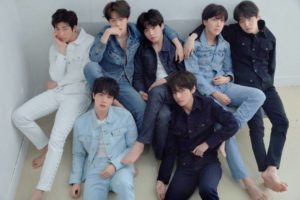
In modern South Korea, pop stars and politics don’t often mix. While some hip-hop acts (such as Epik High) address controversial topics, many idol groups stick to a slick, apolitical formula with a proven record of success. BTS, who just became the first K-pop act ever to top the Billboard 200 album sales chart, have become a record-setting success story in part because of their willingness to buck this convention. My latest essay for Rolling Stone.

In “Gutenberg! The Musical!,” two actors portray 30 different characters (of both sexes!) and sing 15 songs in a show about Johann Gutenberg, the inventor of the printing press. Clearly, this isn’t your typical play.

When entrepreneur Irving “Bud” Levin started the San Francisco International Film Festival in 1957, his intention was to compete with the prestigious festivals already thriving in Berlin, Cannes, Edinburgh and Venice and to establish the U.S. as a viable member of the international film-festival circuit. Today, as its 50th anniversary edition begins (the event runs through May 10), it’s clear that America’s oldest film festival, which features 25 juried awards and is presented by the San Francisco Film Society, has established a venerable presence on the North American circuit — even though it might not necessarily have eclipsed, say, the Sundance Film Festival just yet.

For almost everyone in the entertainment business, awards season culminated with the Oscar ceremony late last month. But for J. Wayne Anderson and Mary Ann Anderson, 2007’s ShoWesters of the Year, the festivities are only just beginning.

More than two decades ago, an Israeli rock star affectionately known to his fans as Poogy decided to create his own film festival. An avid lover of the arts and an actor himself, Poogy invested $35,000 of his own money into the venture and formed a fest designed to showcase the work of Israeli filmmakers. He was unsure of how film fans would react to his project, but he was certain that it was something he had to try.

Slamdance Film Festival co-founder and president Peter Baxter knows all too well what goes into making a movie and trying to find an audience for it. Baxter currently is working with James Zalcman on “Wild in the Streets,” a documentary about a rough English sport that was the precursor to soccer.

A crop of outstanding documentaries bravely examines some of the modern world’s most pressing issues — from global warming to free speech.
Back then, Hollywood was respectable, much like the rest of America. A secret was a secret to be kept, and the studio moguls made sure they were kept.