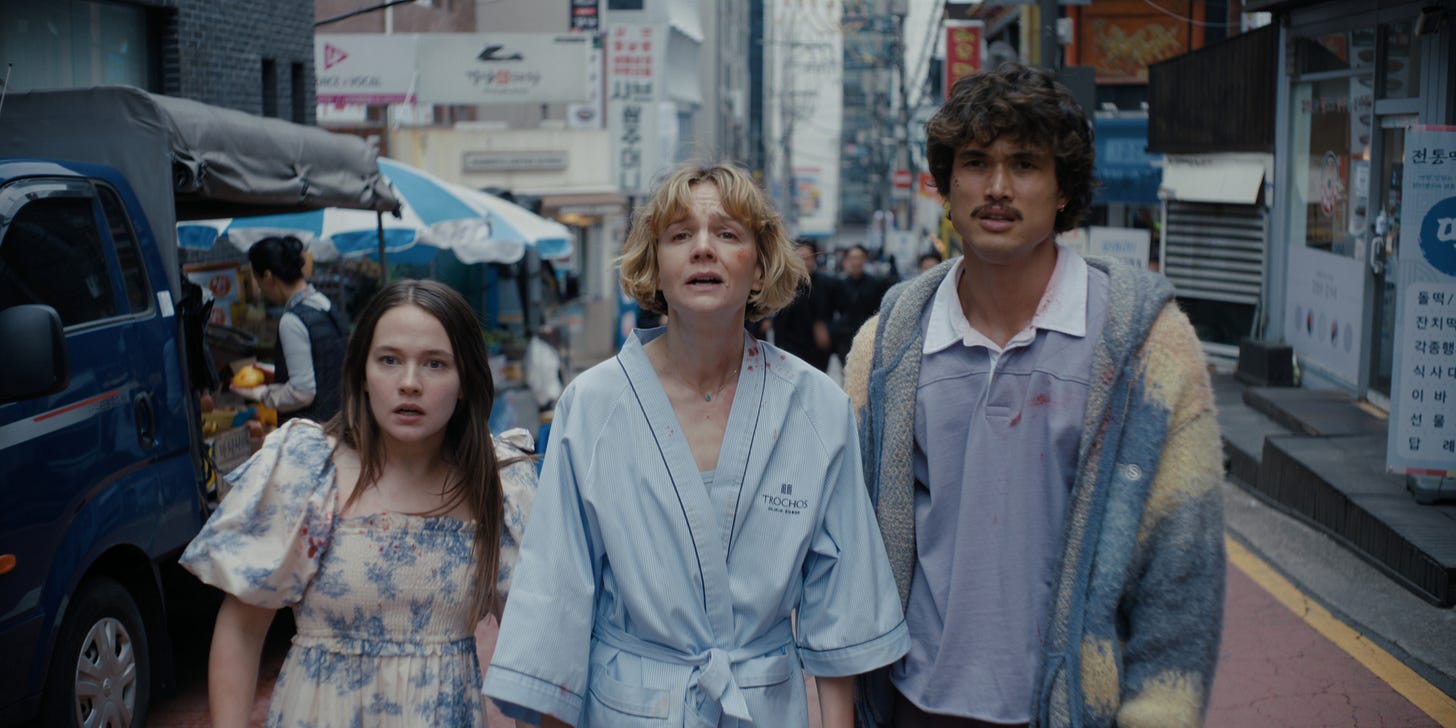
In the second season of the Netflix series “BEEF,” showrunner Lee Sung-jin1 stacks the cast with Korean superstars like Youn Yuh-jung and Song Kang-ho, as well as Korean American rapper Matthew Kim (aka BM of Kard) and British Korean actress Seoyeon Jang. But oddly enough, this current season has a less Korean feel to it than its 2023 predecessor, where Korean American actors Steven Yeun, Young Mazino, and David Choe depicted what it was like for “good” Asians when they don’t live up to the model-minority stereotype.
This second season centers on a white couple, with the Korean cast members acting as secondary characters rather than the main event. But what the show does incredibly well is how it handles a character’s Korean identity when they’re surrounded by people who claim they don’t see color, or that they think of biracial Koreans as being white — as if that’s some kind of compliment of acceptance, rather than an erasure of heritage.
The series stars Carey Mulligan and Oscar Isaac as Lindsay and Joshua, an unhappily married couple whose hoity toity country club jobs are on the line when a Korean chaebol takes over. Austin (Charles Melton) and Ashley (Cailee Spaeny) are their younger, poorer counterpoints at the country club. When the latter couple accidentally catch Joshua and Lindsay having a violent fight, Ashley films the altercation with the intention of showing it to the police — but then decides they can use the footage as leverage to secure better positions for themselves at the country club.
Once Chairwoman Park (Youn Yuh-jung) takes over the country club, the American staff fear for their jobs. But for Austin — who like Melton is Wasian2 — this means that for the first time in his life, his Korean roots are an advantage he can use to bond with Chairwoman Park (Youn Yuh-jung) and her personal assistant Eunice (Seoyeon Jang).

Eunice is a worldly counterpart to Ashley, whose education ended with high school. Meanwhile, Eunice has a masters degree, is multi-lingual and incredibly well traveled. She’s also gorgeous. Austin is drawn to her because of her looks. But by this, I mean he’s attracted to more than her pretty face. In her, he recognizes his own Korean features that were never spoken of or addressed, because everyone wanted him to just be white.
“BEEF” is set in a wealthy California city. And surely Austin must have seen other Koreans and Asians, even if they weren’t in his inner circle. But what this series does so well is make it clear that treating minorities as white still doesn’t make it easier for them to fit in with the majority.
As the son of a Korean mother and a white father, neither of whom raised him to know much about his ethnic culture, Austin understands enough of his mother’s Korean to respond to her, but he does so in English. This linguistic acculturation isn’t unusual for children growing up in a dual-language household where the dominant language is almost always English.
All of this whirls around in Austin’s head when he verbalizes to Eunice what he hadn’t spoken of before — because who was there to listen? His own white girlfriend says she never thought of them as an interracial couple because she doesn’t see color and she views him as white. But he has felt that sting of racism. And as he and Eunice have the kind of conversation about microaggressions and prejudice that Ashley can’t possibly relate to, the latter becomes jealous of their shared connection.

All of this is confusing for Austin. Asked point blank if he’s ever dated an Asian woman, Austin sounds disgusted, and actually says ew, before telling Ashley that it would be like dating his own mother.3
Yet later, he admits, “Am I attracted to Eunice? Yes. Am I drawn to our common heritage? Absolutely. But am I into her? Look, my perspective is I’ve never been around this many Koreans before, okay? My body is like reacting to everything. It’s like epigenetics, you know? Because in the long run, I do need Korean presence in my life, but at the same time, I want us to be together forever. Nevertheless, I do find Eunice attractive, so it’s just all really confusing.”
There is a story arc that stems from Ashley’s jealousy that lands her in the hospital, that is both deeply sad and inadvertently funny. Not understanding what a medical deductible is — and why would she? She’s never had health insurance before — Ashley is at first delighted that she won’t have to pay for her surgery, before she realizes how much she has to cover before her deductible kicks in.
Meanwhile, Austin wants her to get the best care, and asks, “Where the Filipino nurses at?” Asian diaspora will understand this question. We have 정4 with other Asians, even if they’re outside of our own ethnicity.

META MOMENT: In Episode 3, Ashley asks Austin if she should put Bacchus drinks in a gift basket for Eunice. He tells her that the only person he’s ever seen drink it is his grandmother. That scene is a sly nod to Youn Yuh-jung’s 2016 film, The Bacchus Lady.2 In the titular role, Youn starred as an elderly sex worker who sold Bacchus drinks to men. This transaction was a known precursor to sex. While this is a fictional film, it’s based on the plight of poverty-stricken elderly women who have no other way to make a living.
UNDERSTANDING KOREAN CULTURE: People magazine linked a lovely video of Melton greeting Youn with deep bows, with a caption that read, “Chivalry was alive and well on the #Beef season 2 red carpet!” What People didn’t understand is that Melton was showing respect to his Academy Award-winning co-star. The deeper the bow, the more respect. Melton’s bow was at almost 90 degrees.
YOUN YUH-JUNG: Read my interview with the Academy Award winner here.
AIRDATES: Eight episodes — ranging from 31 to 49 minutes each — dropped on Netflix on April 16, 2026. (I initially watched screeners of this season.)
Check the Spoiler Alerts below for more about “BEEF” season 2.
SPOILER ALERTS:
° Song Kang-ho portrays Dr. Kim, the Chairwoman’s plastic surgeon husband. Though famous for his skills, his hand tremors and reticence to stop practicing have made him a liability. After he accidentally kills one of his patients, the Chairwoman springs into action to save his reputation and her wealth.

° After Ashley is released from the hospital, she breaks into Lindsay and Joshua’s house with revenge on her mind. She blames him for withholding access to a skilled surgeon. She reaches into her underpants and takes a handful of bloody discharge and stirs it into a pitcher of their juice. As she leaves, she accidentally leaves the door open, allowing the couple’s dog, Burberry, to leave the house. Burberry is later killed by a coyote. Joshua and Lindsay blame each other, before deciding they should divorce.
° In one of the most disgusting depictions I’ve seen recently, Lindsay gets revenge on Ashley by wiping fecal matter from an airplane toilet and adding it to Ashley’s drink. Actress Carey Mulligan said she had dry heaves while filming that scene.

° Matthew Kim makes his acting debut as Woosh, a hot tennis coach at the country club. In a surprise reveal near the end of the series, viewers learn that Woosh is the son of the Chairwoman’s first husband. When he blackmails her for a higher position in her organization, she tenderly kisses him on the forehead and agrees. He is now a vice president. But shortly afterwards, a truck runs over him, killing him instantly. The only thing that would’ve made Woosh’s final scene better is if it had been the infamous white-truck-of-death (that is prominent in K-dramas).
Kim is handsome, and is a very talented musician. But he was miscast in this role. Holding your own against heavy hitters like Youn and Mulligan is a difficult feat for even seasoned actors. “BEEF” isn’t “XO, Kitty,” where nuance and skill are secondary to good looks.
DON’T BELIEVE ALL KOREANS: Finally, I read something that another Korean American writer had published in her recent newsletter. It is oddly incorrect:

Until 1977, inheritances were almost always distributed to the eldest son, regardless of whether there was a will. But that hasn’t been the case in some 50 years. If there is no will, the estate will most likely be divided between the surviving children.
It’s tempting to believe anything that a Korean says about South Korea. But I advise you to use common sense and caution (even if I’m the one who’s spouting off). Laws and customs change. What was true decades ago isn’t necessarily factual today. And while most of us do our best to be as accurate as possible, errors will get through.
Which is why I end many of my posts with the following:
If I have any facts incorrect, please do reach out and I will fix them (and attribute the correction to you, unless you don’t want to be mentioned). But if you simply disagree with what I’ve written, I can live with that and hope that you can, too. Cheers!
© 2026 JAE-HA KIM | All Rights Reserved
One thought on ““BEEF” Tackles Korean Identity in Season 2”
Comments are closed.