By Jae-Ha Kim
Substack (.pdf)
June 11, 2026
☆☆☆ (out of ☆☆☆☆)
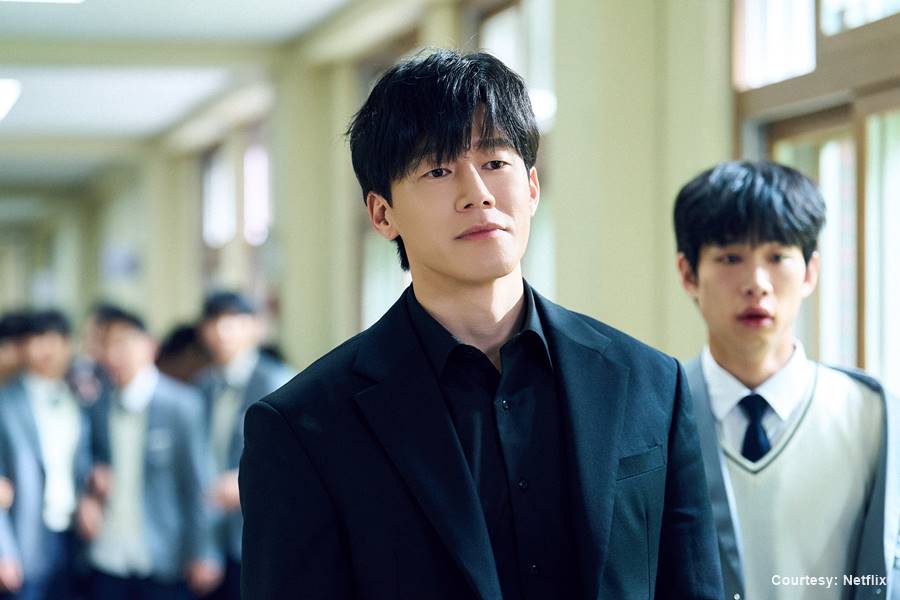
Na Hwa-jin (played by Kim Mu-yeol)
Choi Gang-seok (played by Lee Sung-min)
Im Han-rim (played by Jin Ki-joo)
Bong Geun-dae (played by Pyo Ji-hoon aka P.O.)
↑Note: Korean names denote the surname followed by the given name.
The premise of “Teach You a Lesson” (참교육) becomes clear within the first eight minutes of the K-drama. As a high school bully goads a flinching classmate to “hit me back, you fucking retard!”1 a hand smacks the teenager’s face so hard that he goes flying across the hallway.2
But whereas the protagonist in school-bullying shows (like Weak Hero) tend to be other students who’re standing up for their friends, the hero here is Na Hwa-jin (Kim Mu-yeol), a strapping 30something former Special Forces captain who — as the head inspector of the newly-formed Educational Rights Protection Bureau (ERPB) — literally has permission to enforce an eye-for-an-eye code of justice that adults usually don’t mete out on children.
During this scene, it becomes obvious that the children’s behavior is the product of entitlement, bad parenting, and pencil pushers at schools who do next to nothing to protect the actual victims.
For instance, in this situation, the principal and his minions respond to the commotion by demanding to know why a grown man is hitting a child. But where were these administrators when the teenage thugs beat the weaker students in their own classrooms? Why were they not concerned that kids walked into school fine, but left visibly bleeding, bruised, and often times cowering in fear? Did they view violence in school as acceptable if it was peer-on-peer altercations?
There is a contingent of people who do not approve of adults hitting children. I am one of those people.
But I also recognize that in a fictional setting like this, it can be incredibly cathartic to watch morally reprehensible youngsters getting their comeuppance3 — especially for real-life victims of school violence whose lives were treated as dispensable by those who were supposed to protect them. Also, the fact that many of these bullies look like they’re 30-year-old salarymen rather than middle school or high school students makes it easier to justify their beatings.
How Do Kids Get This Way?

The series doesn’t tackle the issue as to why these fictional students are sociopaths (or maybe even psychopaths). It’s not necessarily low self esteem or even exposure to home violence that’s the root cause. Rather, a study4 by the University of Chicago notes that some aggressive children with conduct disorder essentially enjoy inflicting pain on others.
In the study, researchers compared two groups of 16- to 18-year-old boys (exactly matched on age, sex, and race-ethnicity) with aggressive conduct disorder to a control group of adolescent boys with no unusual signs of aggression. The boys with the conduct disorder had exhibited disruptive behavior such as starting a fight, using a weapon and stealing after confronting a victim.
The youth were tested with fMRI5 while looking at video clips in which people endured pain accidentally, such as when a heavy bowl was dropped on their hands, and intentionally, such as when a person stepped on another’s foot.
“The aggressive youth activated the neural circuits underpinning pain processing to the same extent, and in some cases, even more so than the control participants without conduct disorder” —Jean Decety, Professor in Psychiatry at the University of Chicago

Which leads to the question, might it not be worthwhile to invest in mental health treatments for all students as part of their school curriculum? Why not try to deal with issues before they spiral out of control? And it’s not just the visibly disturbed children who need help. Almost all of us could benefit from talking to a trained professional to address the things we won’t (or can’t) discuss with family, friends, or peers — for whatever reason. While this won’t rid schools of all bullies, mental health iniatitives seem like they could help foster benefits for society as a whole.
It follows that if addressing our mental health became the norm, people would be less likely to be singled out as 미쳤어/crazy just because they are seeing a therapist. And for what it’s worth, I’m talking about a worldwide initiative because — waves hands around — look at the hot mess we’re living through right now. It’s a lot to deal with.
The Cast
Lee Sung-min portrays Choi Gang-seok, the Minister of Education, who spent two years putting together the ERPB after his daughter was killed by one of her high school students. She was also engaged to be married to Na Hwa-jin, which explains why the two are so invested in creating a safer environment in schools.

Their team is rounded out by Na’s underling, Im Han-rin (Jin Ki-joo) — whose fighting skills match that of her mentor’s — and scaredy cat (but tech savvy) Bong Geun-dae (played by Block B rapper P.O.) While I loved the push-pull relationship between these two and that Im is the badass enforcer second only to Na, I wish that her character had been given more nuance. (The flashback the depicted what led her to fight for justice was one of my favorite scenes of the entire series.)
Yes, Im can literally jump out of a window like a flying squirrel, knock out two thugs, and walk away without any broken bones.6 Clearly, she is a tough opeerative who can beat up men twice her size and make them beg. So why did director Hong Jong-chan make her emit high-pitched (and annoying) screams whenever she becomes frustrated (which is often) or angry (ditto)? Surely a trained former Special Forces sergeant like her would be able to handle her emotions better during even the most trying of circumstances.
But this is Kim Mu-yeol’s show from start to finish. As Na, he is debonair, puckish, incredibly capable, empathetic, and — as an elder Millennial — still young enough to make fun of his own outdated kkondae/꼰대7 tendencies (compared to Im’s and Bong’s 21st century sensibilities). He also is a kickass fighter who comes up something a little different in each beatdown. In the quieter moments, though, his eyes convey sadness and helplessness, because all he really wanted was to get married to his fiancée and grow old together.
One of the elements that I appreciated in this show was that time was given to show him grieving. He hasn’t moved on from her death. And they didn’t her memory by pairing him up with the female lead.

There is a lot going on within these fast-paced 10 episodes. While student bullying is at the core of the series, the story arcs also delve into teachers who are in cahoots with overbearing parents intent on getting their kids into the top universities, whether they have to cheat or bribe their way in.
Many of the episodes are based on real-life tragedies that occured in South Korea, most notably the suicide of a 23-year-old first grade teacher. After the police attempted to push the narrative that she died because she was depressed about a breakup with her boyfriend, her cousin unearthed her work logs, journal entries, and texts, which revealed a different story. They were filled with non-stop complaints from parents about the way she taught, how she disciplined the altercations between the children, how she should change the curriculum … They essentially nagged her to her death.
In an interview with the BBC, Professor Kim Bong-he — who teaches future educators at the Seoul National University of Education — attributed these acts of emotional (and physical) violence to a rise of inequality between parents and teachers.
Traditionally, Korea had a very strong culture of respecting teachers, he explained, but because of the country’s rapid economic growth, many parents are now highly educated. “This means they often look down on teachers,” he said. “They think they have paid for them with their taxes. This creates a strong sense of entitlement.”
In another episode, high school students befriend and then bully a shy boy by stealing his Wi-Fi, identity, and bank account. They commit crimes using his name, run up thousands of dollars in debt, and then wash their hands of him. This storyline is based on the recollections of a student who said he was forced to be the Wi-Fi Shuttle at school, and would be beaten if the bullies couldn’t access the internet.
The most insidious theme that runs throughout the series, though, involves a student who supposedly was in love with Na Hwa-Jin’s fiancée, Choi Ga-yoon (Ha Young), and stabbed her to death. (See more in the Spoiler Alert below.)
So the question is, does juvenile justice actually work?8 Oh, you’ll find out in Episode 10 , and it’ll be worth it. I promise.
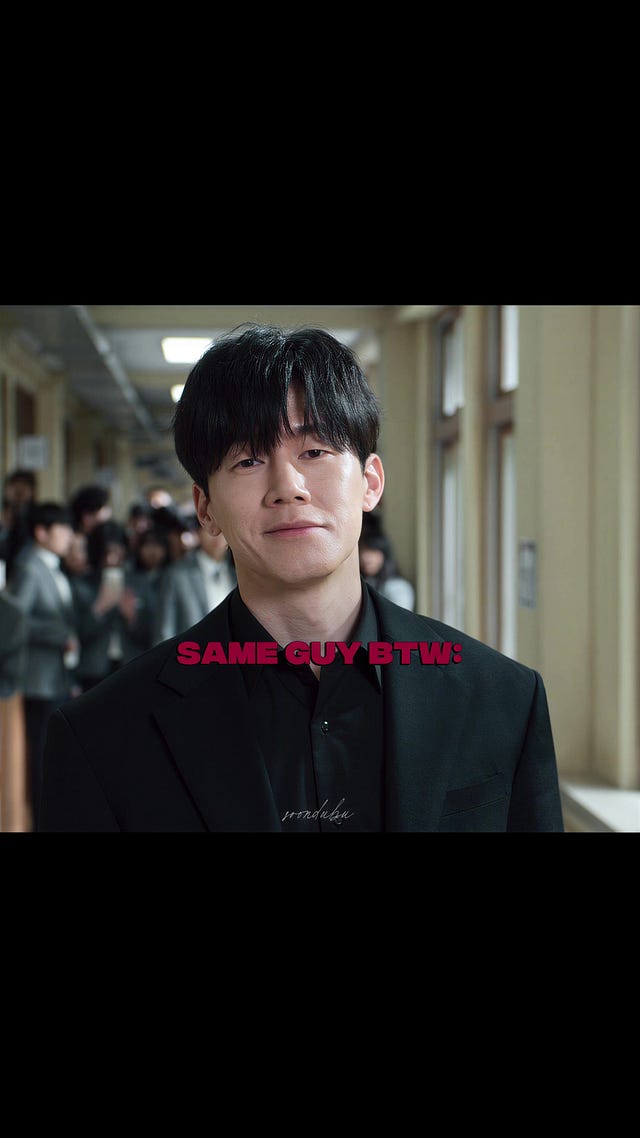
A Different Kind of Juvenile Justice for Kim Mu-yeol
The 44-year-old actor is enjoying a wave of popularity due to the worldwide success of “Teach You a Lesson” — which has been on Netflix’s Top 10 TV Shows in the U.S. list since its debut. The recirculated clip of Kim training for his role in the 2015 K-drama “My Beautiful Bride”9 has also helped.
In 2022, Kim was the male lead in “Juvenile Justice,”10 which also featured his “Teach You a Lesson” co-star Lee Sung-min. In that K-drama, they both played judges dealing with underage children who committed aggregious crimes and knew they were too young to be sent prison. Lee’s character had a son who got caught up in a high school cheating scandal. Kim portrayed a judge who had committed petty crimes in his youth and believed underage offenders like him could be rehabilitated. While watching “Teach You a Lesson,” I often wondered how his “Juvenile Justice” character would deal with the students from his current series. (I doubt his judge character would smack them!)
Kim Mu-yeol is Not the ‘Korean Mark Wahlberg’
I have been cringeing at all the comparisons people have been making, saying that Kim is the Korean Wahlberg.11 😬 I personally don’t think they look remotely alike. Kim is much taller, younger, and is subjectively more handsome. Americans comparing him to a white actor as a compliment — as if he doesn’t have his own decades-long career — is western-centric and condescending.
The most egregious part, though, is that these fans who are just now discovering Kim are literally comparing a Korean actor to a mumbling man who has a felony assault conviction for racially-motivated attacks against Asians and African Americans. His crimes were serious enough that the then teenage Wahlberg was arrested and tried as an adult. And when this is pointed out to people who weren’t aware of Wahlberg’s history, most of these commenters simply do not care because they think Marky Mark is still hot.
Ew. Just stop it. Even if for the sake of argument you believe that Wahlberg is a fine human being now, why would you think it’s a compliment to compare a Korean actor to, well, him?
Airdates
Ten hour-long episodes dropped on Netflix on June 5, 2026. Since this is a Netflix series and an international hit, “Teach You a Lesson” will surely get a second season.12
Spoiler Alert
Cho Gyu-cheol (portrayed by 31-year-old actor Lee Bong-jun) claimed that he had killed Na’s fiancée because he was in love with her, but she was getting married to Na. But that wasn’t the case at all. When she learned that he was running a massive drug ring at their high school, she asked him to turn himself in to the police. He killed her to keep his illegal operation alive.
Sentenced to two years in a youth detention center, Cho manipulates a politician into getting him released early and back into his former school. Playing the part of a misunderstood boy who has been rehabiliated, he wins over some classmates, while setting up others who are trying to intimidate him.
Lee portrays his role chillingly well.
© 2026 JAE-HA KIM | All Rights Reserved
2 thoughts on ““Teach You a Lesson” (참교육)”
Comments are closed.