“Money Heist: Korea” Reimagines Netflix’s Hit Series as a K-Drama — and It Works

The Spanish TV phenomenon gets remade and reset in an imagined North and South Korea, complete with charged political commentary and BTS namedropping. My latest review for Rolling Stone.

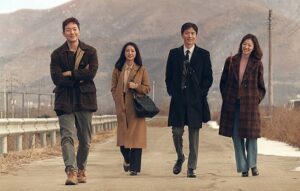
“My Liberation Notes” (나의 해방일지)

“My Liberation Notes” is very beautifully executed in presenting a slice of life that doesn’t offer a fairy-tale ending … or offer finite solutions to ease the characters’ lives. But what this K-drama does do is allow for growth. Who the characters are at the start of the series is not who they are by the finale, and that’s a good thing.

“Our Blues” (우리들의 블루스) Is One Of the Best K-Dramas in Recent Years

At first glance, “Our Blues” appears to be about a somewhat eccentric community of folks in Jeju-do — South Korea’s largest island. And it is. But it’s also about so much more. Over the course of 20 episodes, the series weaves together the complex stories of more than a dozen characters, creating a larger picture of love, forgiveness, and what it means to truly look out for one another.

“Military Prosecutor Doberman” (군검사 도베르만)

“Military Prosecutor Doberman” explores some of the same themes as last year’s superior “D.P.” — but with more fight scenes, comedy and shirtlessness, courtesy of the series star Ahn Bo-hyun (“Itaewon Class”). It also stars Jo Bo-ah as his kickass colleague who’s as full as vengeance as he is.

“Thirty-Nine” (서른, 아홉)

“Thirty-nine” is a reminder that while we’ve all made mistakes in our lives, we can’t continue to punish ourselves forever. Life is short. There is no guarantee of a tomorrow. Be honest and live your best life.

“Twenty-Five Twenty-One” (스물다섯 스물하나)

The burgeoning romance in “Twenty-Five Twenty-One” is based on a strong friendship. But some viewers have pointed out that the story would’ve been more effective if the female lead character hadn’t been underage when they met.

“Hello, Me!” (안녕? 나야!)

“Hello, Me!” is about Ha-Ni, a high school beauty who seemed destined for success. Instead, she grows up to become a mouse-of-a woman who has lost her drive, popularity and — seemingly most importantly — her looks. Through some miraculous force, 16-year-old Ha-Ni appears in modern day Ha-Ni’s life, causing confusion for everyone concerned.

“The King: Eternal Monarch” (더 킹: 영원의 군주)

“The King: Eternal Monarch” was Lee Min-Ho’s comeback drama after finishing his mandatory military service in 2019. Beautifully shot and well acted by the lead actors, the series nonetheless is a bit of a hot mess when it comes to the meandering plot.

“Mouse” (마우스)

If there was a test that determined whether your unborn child carried a psychopath gene, would you trust it enough to terminate your pregnancy? Or would you believe that regardless of your child’s genetic makeup, you could raise him to be a good person who wouldn’t grow up to be a killer? Would you trust nurture or nature?

How “All of Us Are Dead” Uses a Zombie Attack to Examine Korean & Global Issues

There’s a lot to unpack underneath the surface of Netflix’s hit zombie thriller. Here are six examples of how “All of Us Are Dead” utilizes the zombie genre to reflect on societal issues that are reflected around the world, with a focus on some issues unique to South Korea.

“The Hymn of Death” (사의 찬미)

“The Hymn of Death” is a bittersweet three-hour mini-series that tells the real-life story of Yum Sim-Deok — Joseon’s first soprano — and Kim Yoo-Jin, a renowned writer and playwright. Set during the period when Korea was under Japanese rule, the tragic story is familiar to many Koreans.