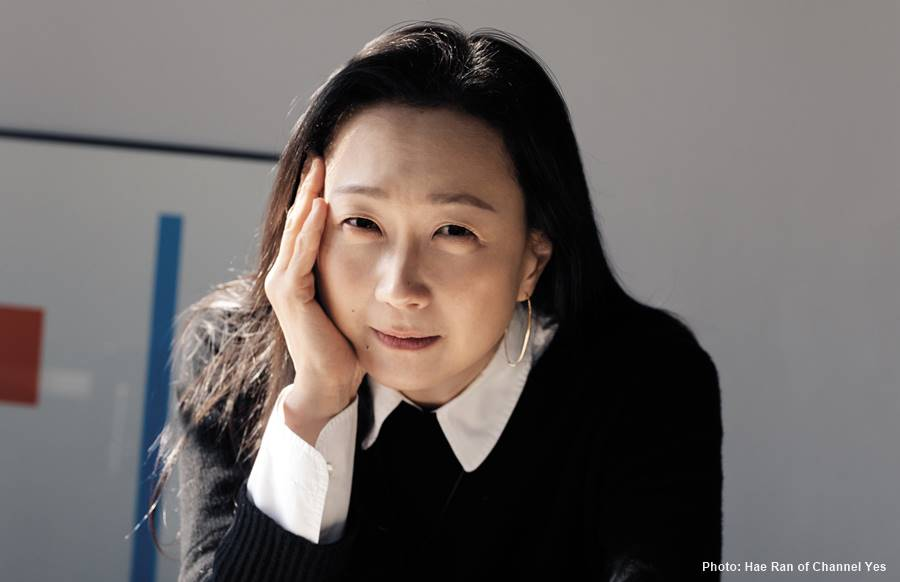
By Jae-Ha Kim
Substack (.pdf)
October 2, 2026
In Korean dramas, there are often references to umchina/엄친아. The Korean portmanteau is derived from the phrase 엄마친구아들, which literally translates to mother’s friend’s son. Parents use this 엄친아 to compare their children to someone else’s son, who honestly may not even actually exist. While the phrase specifically refers to a son, it is also used to address high-achieving daughters.
All I can say is, I’m glad my parents didn’t know Min Jin Lee’s parents,1 because Min Jin Lee is a real-life 엄친아.
Many book lovers already know that Lee is the bestselling author of the revelatory novel Pachinko, which was a finalist for the prestigious National Book Award. Former President Barack Obama selected Pachinko as a must-read book in 2019:
This is a captivating book I read at the suggestion of a young staffer on my team — a historical novel about the Korean immigrant experience in wartime Japan. Min Jin Lee draws you in from the first line, “History has failed us, but no matter.” The book is named after a popular game in Japan that’s a bit like a pinball machine — a game of chance where the player can set the speed or direction, but once it’s in play a maze of obstacles determines the outcome. Staying true to the nature of the game, Min Jin Lee’s novel takes us through four generations and each character’s search for identity and success. It’s a powerful story about resilience and compassion.

A writer-in-residence at Amherst College — though she’s currently on leave through June 2027 — Lee graduated from an Ivy League university (Yale) before studying law at Georgetown University. She worked for a couple years as a corporate attorney in Manhattan before deciding that working 100 hours a week for the rest of her life wasn’t what she wanted to do. She had longed to write for a while but, at the time, felt it was too luxurious of a choice to make.
But ask her if she feels it was wasteful to leave the legal world, and she will say an unequivacable no. A self-described nerd who enjoys studying and learning, Lee said that law school prepared her well for the extensive research she puts into her books, where fact and fiction coincide to tell universal and relatable stories. About a decade after she quit her job, she released her first bestselling novel in 2007. At 562 pages, Free Food for Millionaires centers on Korean-American protagonist Casey Han and explores class distinctions, clash of cultures, and the desire to fit in as an other. She followed that book up with 2017’s Pachinko, and devoted almost a decade before releasing American Hagwon.
NOTE: In the following interview, there are a few small spoilers. But that shouldn’t take away from your enjoyment of American Hagwon.


When Free Food for Millionaire was released, I remember being in St. Louis and reading an article about you in the St. Louis Post-Dispatch. I wasn’t on your publisher’s radar at that point, but I tracked you down for our first interview. That was almost 20 years ago!
Well as far as I’m concerned, we’re cousins now. So yes, done deal.
Except you’re the super talented umchina that I would be compared to.
[Laughs] No, no, no. I’m your goofy super nerd cousin who picked up on the half ring [when you called]. My mother is a Kim, so we actually could be cousins. Did you do 23andMe?
I never have. I’m always suspicious about having my DNA out there. I don’t want to already be in the system if I ever commit a crime.
Oh my, God! Forget this interview. I want to know what crime you’re going to commit.
Um, allegedly … If I knew my son was wrongly accused, I would do everything in my power to help. If I knew he was guilty, then as much as I love him, off he goes. But if I know he’s innocent, I would ride at dawn as they say.
I’m from Queens, which means that I’m very tribal. I think that’s fair. It’s actually totally in line with motherhood. In light of all the research I’ve done over the past 30 years about parenting, I really believe that parents can justify almost anything for their child and other people understand [in a way they wouldn’t] for your sibling, or maybe not even for your own parents. But for your own kid, people understand.
OK, getting to American Hagwon now, which I thoroughly enjoyed so much that I saved the last chapter to read because I didn’t want it to end. There is a point where Bo is studying so desperately hard to get into a SKY2 school. I felt so bad for him because he had invested so much time that he wouldn’t let himself stop and change his goal.
It was tragic, but I also think that even though he doesn’t get what he wants, he becomes a deeply wiser person due to that experience. And you know, when he decides to become a psychologist and not a psychiatrist, it’s a decision that a lot of people in his field don’t understand. To me, it made a lot of sense that a person like this really would say, “You know what? I have failed in public so often that I’m going to do what I want to do.” And because he was able to go to a community college and then a state school, and then accept the fact that his fees will be significantly lower, and have a part-time job, he becomes a better person.
I loved that part of the book for a lot of reasons, one being how relatable it is. Unless you are very wealthy, a legacy, a scouted athlete or someone so unique that schools will offer you a full-ride scholarship, it is unreasonable to think most students and their parents can pay $90,000 a year to attend an “elite” school. Go to a state school, or community college and, if you want, transfer later to a four-year university.
I actually really encourage it. I think there should be a mandatory gap year. I have heard so many tragic stories of kids who go to very, very fancy schools. And it’s not just the losing the money.
Some students aren’t meant for those high-pressure schools where they know their parents are spending money they don’t have.
Yes, some kids break down and spiral. They don’t know how to handle and self advocate for themselves because many of them have just been really good students. They haven’t actually ever had to deal with conflict before.

The way school is viewed in the U.S. and Korea is very different.
Right, in the U.S., the kids who don’t study, the kids who are extroverted and who have personalities do well, too. In America, it’s not so much about your academic resume. Look at the Fortune 500 companies and look at the CEOs and where they went to school. Over and over again, they weren’t the top students.
There are so many K-dramas that emphasize how important it is for students to graduate from a SKY school in order to get a job at an important company. The Korean version of “Suits” hired law school students from Seoul National University, and “Beyond the Bar” hired from SNU almost exclusively. And just about all of these shows have plot points where students who graduated from a school outside of Seoul, or worse, from a rural area, are made fun of and shamed because of where they got their education. From your research, does this reflect how it actually is in Korea?
I think that there’s quite a bit of truth. Your resume is very indicative. That said, I think you can ask any Korean person on the street — and I have! — “Can you tell me honestly, do you know somebody who went to Seoul National, or Ewha Womans University, or Korea University, or Yonsei University whose lives did not work out?” And every one of them can give you an example. And yet, the attachment to having a highly selective school be the dream for their kid has not diminished, which I think is so interesting. It’s kind of like you have counterfactual evidence, but then what?
Does this desire for prestigious schools remain when Koreans immigrate to other countries?
Besides America, when Koreans go to other countries, they’re not as attached because there are so many top public schools. McGill University in Canada is among the best schools. In Australia you have University of Sydney or University of Melbourne. There are options.
I feel like in the U.S., they’re looking for Ivy Leagues like Harvard or Yale. I remember watching an episode of “Running Man” where Jong-kook was making fun of a Korean American singer named John Park, because John had studied at Northwestern University. Jong-kook said that wasn’t a difficult school to get into. And I was thinking, Jong-kook went to Hansei University,3 which isn’t in Seoul by the way, and isn’t on the same level globally as Northwestern. But because he most likely had never heard of it because it wasn’t Harvard, or Yale, or Stanford, he felt comfortable mocking his guest even though he himself hadn’t graduated from a SKY school.
I’m going to say something really controversial, and people are not going to want to hear this. But I try not to use the word elite because it’s a misnomer. They are highly selective. The language of highly competitive or highly selective just means that it’s a numbers game. It’s not necessarily because we all agree that those schools are elite. Once you go there, you have to start the race again being selected into clubs. This isn’t like the Yale kids are rejecting the Harvard kids. No, the Harvard kids are rejecting their own Harvard kids. So you don’t have an overall sense of sunbae/선배 or hoobae/후배.4 It only exists in your tiny little circle. I don’t want to pick on Harvard, because it’s like that at a lot of these schools, right? And it’s because what they’re doing is they’re making the funneling easier for the employers.
I have heard that the pay scale for hagwon teachers in Korea fluctuates depending on multiple aspects. For instance, if I went to Korea to become an English teacher, I would not be in demand because I’m older and ethnically Korean, and therefore don’t look like what many people think an English speaker would look like.
From what I saw, the Korean Americans who have our kind of background do very, very well in Korea. I interviewed many of them and I didn’t hear about that experience you mentioned. But that said, it depends on what they taught. So for example, let’s say you taught writing, you would get a premium value. If you taught speaking, I think that you would probably do very well because you went to a fancy college and that also does determine your rate. But it really depends on what kind of contract you sign and how you negotiate. There are hagwon owners who give out misleading contracts.
My sister had this theory that while we were considered academically-gifted in the U.S., we probably would have been categorized as normal or maybe even stupid in Korea. What kind of student were you?
When I first came to America, the public school in Queens had this thing called advanced, normal or slow. My older sister and my younger sister — they didn’t speak English then either — were both immediately tracked into the advanced classes. However, I was in slow for two years, so my parents are always like, “You know what? We’re not going to expect very much from this child because in America she’s dumb.” [Laughs] I don’t tell this story often, but I’m happy to share it with you because I think there’s a kind of assumption about the kids in Korea and at least for me, I think a lot of it’s because I’m a little neurodivergent. I wasn’t diagnosed as a kid because my parents were busy and I didn’t get glasses for a long time when I needed them. I don’t think we recognize that neurodivergence of kids in Korea. We’re automatically assuming that every kid there is a genius, and that isn’t true.
But you had skipped a grade when you came to the U.S.
Yes, I did, but so did my sisters! [Laughs] And they did fine in the advanced classes. I was definitely the problem child academically and it was this way for a really long time. And I was bullied a lot as a kid because I didn’t know how to talk to kids, and we didn’t have nice clothes because we didn’t have money and my parents were letting us wear my cousins’ hand-me-downs, so it was all of it. Our experiences are not just about our academic performance, right? And I think that’s the thing that I’m constantly trying to explain about Koreans is that I really wish teachers and parents and community members would really allow our kids to have just as complex humanity as anybody else. We’re not better. We’re not worse. We’re just as complex.
After doing all this research for a decade and writing American Hagwon, are you grateful that your parents didn’t enroll you in hagwons?
You know, my mother is really interesting because she was a piano teacher. She had studied music at Yonsei, which in her generation was weird, because girls usually went to Ewha Womans University. And her attitude about education, which she still believes today at 86 years old, is that you can’t make a kid study. Whenever people ask her, “How did you send all three of your daughters to law school?” she says, “I don’t know. I didn’t do anything.” She has this educational attitude that you have to believe in your kid, and your kid will show you what they want to do. If you ask her today, she’ll tell you the same thing. If you said to her, “Mrs. Lee, what do you think about my kid going to be a freshman at this college?” She would immediately put your mind at ease and then say, “You know what? I trust him. I trust you, and I’m asking you to trust your kid.” My mother would just say that.
Wow. That’s not the attitude a lot of Korean diaspora parents have. Especially first generation immigrants.
That’s who my mother is. So I didn’t go to hagwons, but not because she didn’t think about it. But with that said, in high school, I wanted to take the Princeton Review, so I asked my parents for the money, because all of my peers were taking the Princeton Review. At the time in 1985, it was kind of expensive. Maybe $500, which was a lot of money back then. My mother gave me the money, but that was in line with her educational philosophy that I was the one who wanted to go. My older sister didn’t ask for it, so she didn’t go.
I was wondering how you fit in with your peers when you were a new immigrant.
I was not popular. And also, I think the fact that I can speak to you in this manner on the phone has a lot to do with the fact I’ve taken so many classes. I have gone to the hagwon equivalent of how to be normal.
OK what kind of classes are those because I’d like to be normal, too!
[Laughs] No, you’re like an A+ student already. You would have been the prom queen.5 I took two public speaking classes in the summertime during high school. It wasn’t like I was learning calculus, but I knew there was something I needed to deal with this sort of deficiency I had about public speaking. I wanted to fit in.
And did you?
Well, I don’t feel afraid of social encounters in the same kind of way I did then. I definitely get nervous before every public speaking event. But I do all the homework that’s required to handle it. So I never phone it in. I’ll even have looked up the size of the room and where people will be sitting. You learn in public speaking that if you understand the audience, then you will have a better experience. And all of that does allay my sense of anxiety or worry.
In those early years when you were shy about speaking in public and didn’t speak English yet, how did you reconcile yourself with the fact that you didn’t have many friends?
I’ve had wonderful, wonderful friendships in New York during my lifetime. But at that time, having my family and feeling very strong about my background was a real consolation to me. I’m not trying to minimize my experience, but I think that being from a very tight-knit family was enough for me.
Okay, so I know I was only supposed to get 30 minutes for this interview and I’ve exceeded that by twice that time…
We’re cousins. Whatever you want.
Thank you, Min, for this interview, for your books, for standing up for those who have no voice, and for putting so much time and effort into our community.
No, thank you. Whenever there is a crisis, whether it’s the tiniest or largest in Korea, you speak on it. I always think, “Oh yes, Jae-Ha Kim got it right.”6 Thank you, thank you for all your hard work. I’m reading it, I’m noticing it. I think it’s really terrific and I really encourage your work. I’m a subscriber!
Oh my gosh! No, you’re the one who is doing so much!
I think you’re amazing.7 There’re so few who are out there who are doing it in such a thoughtful way. Your voice has so much integrity, so I really respect that. May we always be known by the quality of our work.
American Hagwon is in stores now. Having read the ARC8 over the summer and again more recently, I can confirm that you will appreciate the novel just as much on the second reading. To learn more about Min Jin Lee, check out her website minjinlee.com.
To read the article I wrote about Lee for my news syndicate in September, you may read that here. It should also be in print in outlets nationwide this Sunday. I’ll add that later.
© 2026 JAE-HA KIM | All Rights Reserved
1 Actually, I know the Lees and the Kims would’ve gotten along famously!
2 SKY is short for the three top universities in South Korea: Seoul National University, Korea University, and Yonsei University.
3 To be clear, I don’t care what university he (or you!) graduated from. The process of learning is much more important than where the degree is from.
4 Sunbae/선배 and hoobae/후배 refer to people in school and at your job who are older (sunbae) or younger (hoobae) than you. But there are also instances where they actually may be younger or older than you, respectively. For instance, a man who went to serve in the military straight out of high school might not enter college until he is 20. A 20-year-old woman at school could be his sunbae, because she has already been a college student for a year or two. Yoo Jae-suk is younger than his “Running Man” castmate Ji Seok-jin. However, because he started his show business earlier than Ji, Yoo is the latter’s sunbae.
5 Reader, I would not have been the prom queen. But I am not shy about speaking in public, even if it makes me nervous.
6 At first, I wasn’t going to include this portion because it could rightfully be viewed as self-aggrandizing. But at the risk of using Lee’s kind words to pat myself on the back, I added it back into the piece, because I believe it’s important to know that we are being seen for the work that we do.
7 This is the first interview I’ve ever done where the subject asked about my health. I didn’t include that portion, because we discussed a few topics off-the-record.
8 Advanced reading copy.
One thought on “It’s Min Jin Lee’s World – an Interview with the Bestselling Author of “American Hagwon””
Comments are closed.