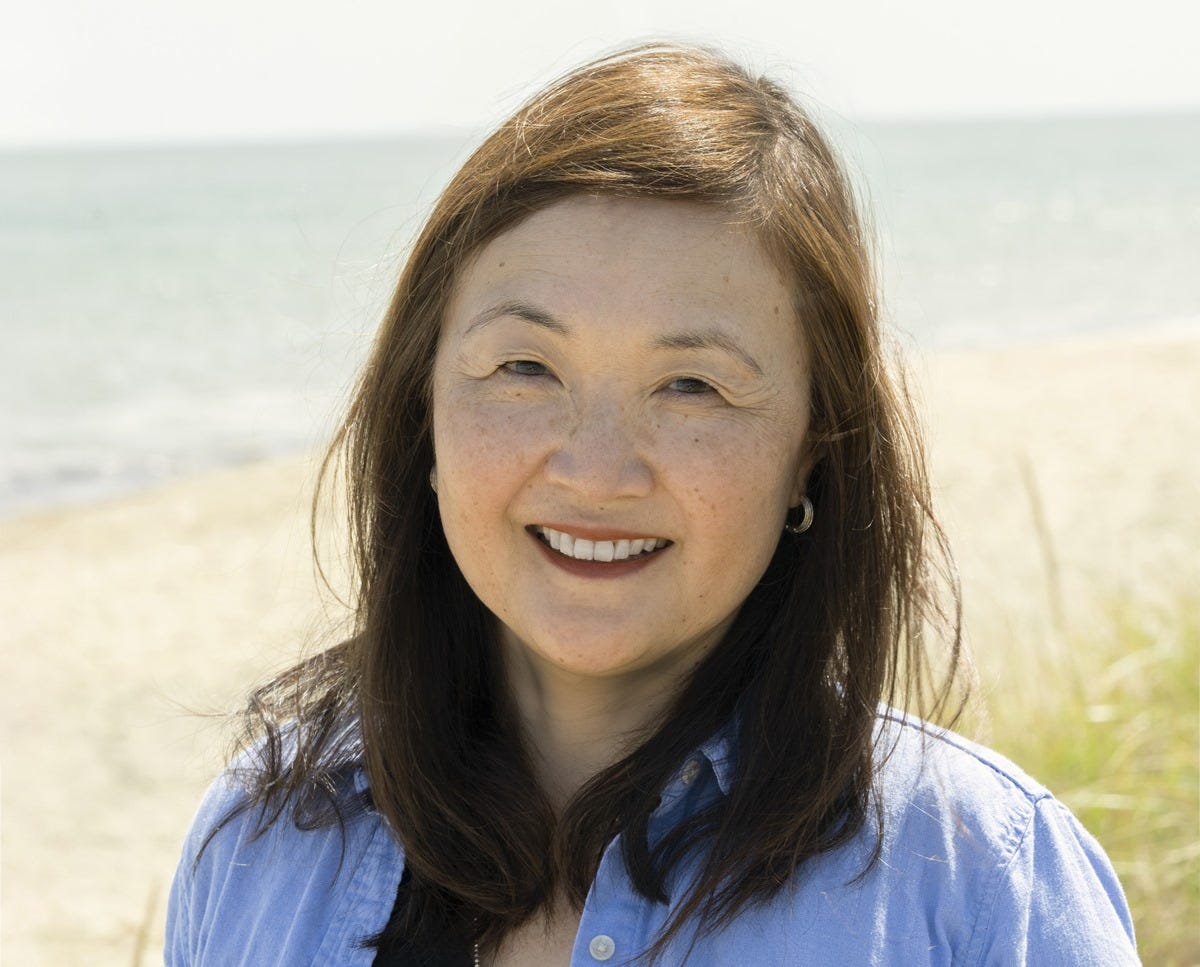
If you’ve read Jimin Han’s earlier novels — A Small Revolution (2017), The Apology (2023) — you already know that the Korean American author masterfully creates worlds that blend fiction with non fiction and transports readers to eras that feel both distant and near. Her most interesting characters tend to be ordinary people leading somewhat mundane lives. But with her nuanced writing, Han weaves meticulous backstories for the characters, leaving us wanting to know more. We end up caring very much about these people, even if we don’t always like them.
Her latest book Dreamt I Found You references a famous Korean folktale that centers on Chunhyang and Mongryong. While some people have compared their love story to that of Romeo & Juliet, I would disagree. Shakespeare’s star-crossed lovers were equals, hailing from prominent and powerful families that hated each other. There was no power imbalance between the two (though that didn’t save them from tragic deaths).
But The Tale of Chunhyang is a story of resilience (that ultimately offers a happy ending). While Mongryong was the son of a powerful magistrate, Chunhyang was born to a kisaeng/기생 — the Korean equivalent of a geisha. Kisaeng were highly-trained in all the refined arts of a noblewoman, but they could never rise above their station. Ordinarily, the matrilineal caste status would’ve meant that Chunhyang was destined to live as a kisaeng like her mother. However, because her father was a nobleman who favored her mother, she was allowed a little more leniency. Still, her low social status was a detriment to everyone except Mongryong, who loved her unconditionally.
We were at my cousin Channing’s house, in the woods of a New England town, when our grandfather told us the Korean story of Chunhyang and Mongryong. With the distant sound of the Atlantic Ocean’s surf crashing into the rocks behind us, we sat in a clearing on tree stumps. It was late morning in the summer. The sun filtered down through the green leaves above our heads. Channing and I were nine years old. …
Harabeoji drummed his fingers on his knees. He said, “‘The Tale of Chunhyang’ is a pansori. That’s the Korean name for a story you sing. But I’ll spare you my singing voice.” He let out a laugh. I told him I wouldn’t mind if he sang. Channing said to just get started however way he wanted to tell it. He nodded and began. Our grandfather’s voice was deep and gentle. He started with the setting rather than once upon a time. “The same story happened over and over again,” he said. “But the place — the place changes.” — excerpt from Jimin Han’s novel, Dreamt I Found You

In the following interview, Han shared more about her novel’s plot, the research that took her back to Korea (where she was born), and how her protagonist’s city of choice is an homage to her own childhood.
For some readers, Dreamt I Found You won’t be a retelling. How did you navigate your storytelling so that it doesn’t matter if the audience is familiar with Korean folklore or if this is something completely unfamiliar to them?
My hope is that readers will connect with the narrator, Dahee Shin, a thirty-year-old Korean American woman who lives in the U.S. but longs to know more about the Korean culture of her parents and grandparents. Dahee’s cousin, Channing, who is the same age as Dahee, has a different interpretation of this famous love story. Readers will learn how stories shape our sense of self and give us a map of what we can expect in our lives.
How different is the Korea we absorb in pop culture to the reality of being there?
Atmosphere and setting can’t be conveyed through movies or K-dramas. Proportions are different, the smells, and those details really helped me in writing the mythical qualities of this famous love story. Because Chunhyang and Mongryong fell in love in a particular place that is so specific, I had to go to Namwon. And East End is a combination of my childhood in Rhode Island and writing retreats in Cape Cod.
All your books have a sense of really being there for readers. How important have your previous travels been when it came to fleshing out the characters’ backgrounds?
Essential, really. They were my window into the grandfather and the parents of the main characters in the novel. Going to South Korea even helped me understand Minjae, the main love interest, because he came to the U.S. for boarding school but spent most of his early years in Seoul. I have my own parents to help me understand their generation, but there’s nothing like being in a city listening to people and watching them.
Can you talk a little bit about the settings that you put Dahee in?
I love New York City now and I put Dahee there as a teacher in the public school system. When I was six years old, my parents moved from Providence to New York City.
Just them?
Yes, my older brother and I lived with my aunt and uncle for a year so we didn’t have to change schools. Every weekend, my 10-year-old brother and I would board a Greyhound bus for a three-hour ride to Time Square. We had no one to look out for us two kids [with] the bus making stops along the way, surrounded by adults.
OMG!
I would never put my kids on a bus like that at that age! Somehow, we made it each time and my parents with our baby brother would meet us at Port Authority and drag us to some obscure restaurant. The streets were dirty and noisy, and I remember being tired and hungry and scared. My parents didn’t have much money and didn’t think about what young children would like other than food. I think my father in particular used it as an excuse for himself to take us places he wanted to go. The food was always good, but we walked a lot. And now it’s my favorite part of New York City, the walking and the food. The search for that obscure spot that no one has heard about yet.
What is a pleasure of being somewhere else?
Does it qualify if I say I love waking up really early, like sleeping with the curtains open so the sun wakes me in a hotel? At home it’s so hard to get out of bed, but when I’m traveling there’s this anticipation for the day to begin and I think when I get home I’m going to do this — get up early — and then I don’t. I love being up when everyone else is asleep. Feels like I’ve got this secret power of more time than I thought I had. The clock moves so slowly in those early hours. It feels like magic when everything else in life seems to be slipping by too fast.
I can’t end this without asking, what’s your favorite K-drama?
“Our Blues,”1 which is about a group of friends who grew up on Jeju-do. Some have left and others have stayed. I love all the misunderstandings and ways this group of friends care for each other.
Have you been to Jeju-do?
I’ve been trying to get to Jeju-do. Every time I’m in South Korea, I try to squeeze it in and each time I fail. One of these days, I hope to make it. I even had tickets for a flight and had to cancel them at the last minute because of time [constraints].
A huge thank you to jimin for doing this interview with me. You may read more of her work on her Substack and her website.
© 2026 JAE-HA KIM | All Rights Reserved
One thought on “Jimin Han’s “Dreamt I Found You” Retells a Famous Korean Folklore”
Comments are closed.