By Jae-Ha Kim
Substack (.pdf)
April 26, 2026
Youn Yuh-jung is six decades into an illustrious acting career that few thespians of any nationality have matched. After making her K-drama debut in the 1967 series “Mister Gom,” the actress landed her breakthrough role in Kim Ki-young’s 1971 film Woman of Fire.
International fans probably know Youn best for her work in U.S. productions like the series “Pachinko,” and the films The Wedding Banquet and Minari. In the latter, Young portrayed the doting grandmother of an immigrant family that was struggling to make a home for themselves in rural Arkansas. When she won an Academy Award for Best Supporting Actress for her transcendent performance in Minari, Youn made history as the first Korean actor to be honored with an Oscar.
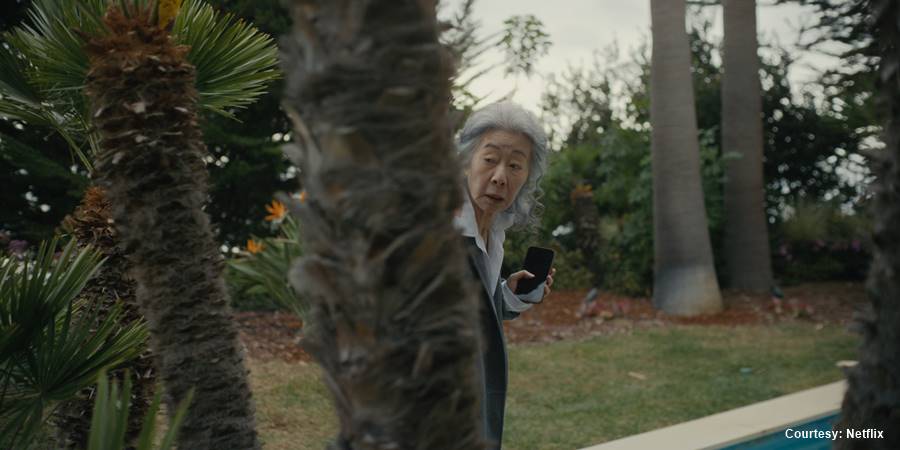
In her latest role in the second season of “Beef,” Youn, 78, portrays the powerful billionaire of a South Korean chaebol conglomerate, who buys an expensive California country club as an investment property. A ruthless businesswoman, her one weakness is her much-younger and inept plastic-surgeon husband (played by Song Kang-ho), who she dotes on.
A day before the new season of “Beef” premiered on Netflix, Youn and I did a video interview over Zoom. Calling from her New York hotel room, the veteran actress was gracious with her time as we discussed the show, her career, and what it felt like living as a minority in the U.S.
This conversation has been edited for clarity and length.
There is a scene where the young protagonist, Ashley (portrayed by Cailee Spaeny), is making a gift basket for your character’s personal assistant, Eunice (portrayed by Seoyeon Jang). And she wonders if she should throw in some Bacchus1 bottles, because she heard Koreans like them. The first thing I thought of was your film, The Bacchus Lady2, where you portray a powerless character — the complete opposite of Chairwoman Park. Did you know that line was included?
No, I didn’t have any idea. [For my scenes], [screenwriter and director] Lee Sung Jin told me everything [to do], but I haven’t seen the show yet. You know, I did [this series a] year ago, I think. And then at my age, you forget about everything.
Oh no, maybe I spoiled it for you!
It’s okay.
You filmed Minari in Tulsa, Oklahoma, and the film got across perfectly what it felt like for Korean immigrants trying to assimilate into a country that was completely different. I know that you lived in Florida for 10 years3. Did you feel any culture shock or a sense of isolation when you were new to the U.S.? Or did you just kind of fit right in?
Back in those days, the middle part of the 1970s, there were no Koreans at all there. I went to a Southern Baptist church. Of course, we were the only Koreans. Some became friends and came to my house and they tried to open the refrigerator to see what I am eating. They were very curious because they had never seen Oriental4 people, I think, at the time. So I was like a monkey in the zoo.
Was that uncomfortable for you?
At first it was kind of uncomfortable. Then I got used to it. They were very curious about [Koreans]. Some people only remembered Korea from the Korean War, so they kept asking about it. A very conservative old lady asked me, “Do you have the same sky as in America? Is it the same blue.” That was a very interesting question. She was a very old lady at the time — maybe she was 80something.

You moved back to Korea quite a while ago, but both your sons live in the U.S., right?
Yes, one is living in Los Angeles and one is living in New York.
So my friends who are in L.A. have joked that when they know you’re in town, they hope they can see you out and about in stores, but never have.
[Laughs] When I was younger, I was always running around. I was curious about everything. But not anymore. Mostly, I’m here for the work, doing press or some shooting. So I try to save my energy. I just mostly stay in my bed to try to memorize the lines. That’s all I do. My work schedule is busy. Yesterday, I think I finished working in Washington, D.C., at about 2:30 in the morning. It was a very hectic schedule.

Have you ever been to Chicago?
I went to Chicago a long, long time ago when I first arrived in America. O’hare was my first stop. We didn’t have a direct flight at the time. All I remember about Chicago is that it was so cold and so windy.
Yes, when we immigrated to the U.S., we flew to Anchorage first and then to Chicago. Anyhow, I know our interview time is over, so thank you so much for this!
Thank you for having me. And, did you watch “Beef”?
I watched both seasons and really enjoyed your season.
Really? Thank you.
Thank you very much. Watch out for the Bacchus drink scene that I mentioned!
I’ll check it out. Thank you. Bye.
© 2026 JAE-HA KIM | All Rights Reserved
* If you’re interested in reading an article delving into the Korean elements of this season’s “Beef,” let me know in the comments!
1 Bacchus-F is a South Korean energy drink.
2 The Bacchus Lady is a 2016 film that starred Youn as an elderly sex worker. She sold Bacchus drinks to men. This transaction was a known precursor to sex. While this is a fictional film, it’s based on the plight of poverty-stricken elderly women who have no other way to make a living.
3 In 1974, Youn retired from acting and married singer Jo Young-nam. They moved to St. Petersburg, Florida. In 1984, she moved back to Korea and resumed her acting career. The couple divorced in 1987.
4 Keep in mind that when Youn temporarily lived in the U.S. during the 1970s, “Oriental” was the word used to describe Asians. It was not an offensive word in that era.
One thought on “Oscar-winner Youn Yuh-jung is in Her Renaissance Era, and She’s Nowhere Near Done”
Comments are closed.