By Jae-Ha Kim
Substack (.pdf)
April 17, 2025
Every day, there seems to be news about the Korean supergroup BTS. They released their much awaited post-military album Arirang. The septet starred in their own Netflix documentary, BTS: The Return. And they’ve already kicked off their world tour, which is slated to end on March 14, 2027 in the Philippines.
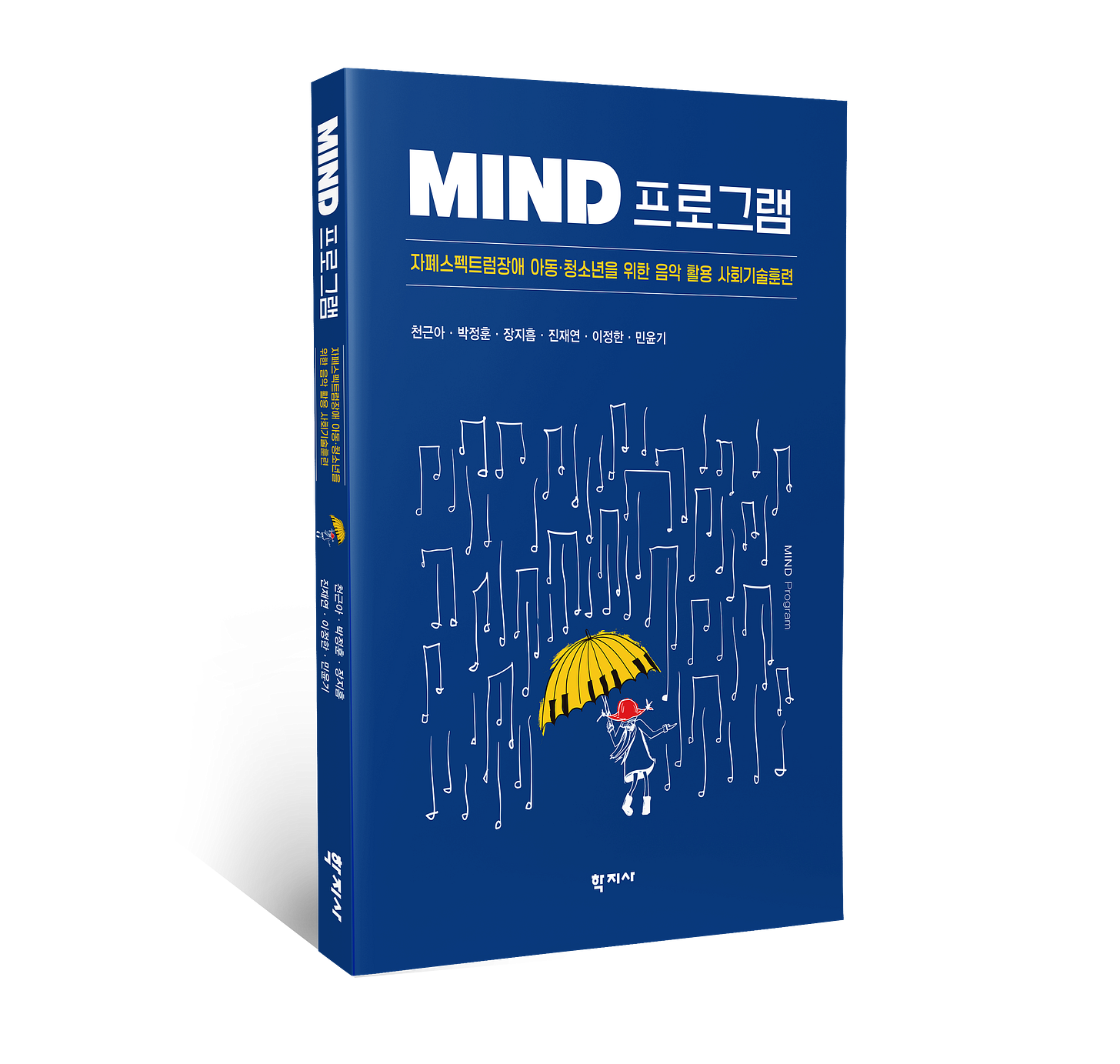
But something that didn’t get enough attention (in my opinion) is Suga co-authoring the book, MIND Program1, with experts from the Yonsei Severance Hospital2. The MIND in question stands for Music, Interaction, Network, and Diversity, and the book offers a music-based approach to developing social skills for children with Autism Spectrum Disorder (ASD). (Suga’s fans may recall that the music star donated $3.5 million to that same hospital in 2025 to establish the Min Yoongi Treatment Center3.)
HOW DID THIS BOOK COME ABOUT?
Due to a pre-existing injury, Suga was assigned alternative service (from 2023 to 2025) rather than active combat duty like his bandmates. While employed as a public service worker, he began planning ideas for MIND with Cheon Keun-ah, who specializes in child and adolescent psychiatry. Around the same time, Suga quietly volunteered to work with children with ASD.
While some naysayers have said he only did this to get back in the public’s good graces after his much publicized scooter incident, I’d argue that celebrities don’t usually put in this much time, effort, or money when making public mea culpas. They issue apologies, disappear for a while, and then pretend it never happened.
But this book wasn’t written to make a lot of money or top the world’s bestseller lists. It’s an academic book aimed at a specific market.
WHAT IS AUTISM?
According to the World Population Review, “autism is a neurological and developmental condition related to brain development. Autism impacts the way individuals perceive and socialize with others and interact with their surroundings. Signs of autism can usually be observed in the early childhood years. Autism is defined by a specific set of behaviors that affect a person’s ability to interact and communicate with others. There are different degrees of autism, but some common behaviors associated with this disability include poor motor skills, repetitive behaviors, delayed speech, difficulties with reasoning, very narrow interests, and impairments in social interactions and communications (such as a diminished ability to detect social cues).”
ANDREW WAKEFIELD SPEARHEADED THE ANTI-VAX MOVEMENT
Andrew Wakefield was a British gastroenterologist and surgeon who, as of 2010, was stripped of his medical license. Why? For professional misconduct. In 1998, he presented a research paper based on a small sample group of 12 children, and claimed that the MMR vaccine — for measles, mumps, and rubella — led to increased rates of autism. Though scientists conducted epidemiological studies and disavowed his research as flawed, and though his publisher retracted Wakefield’s paper, his initial claim became the kindling that sparked the anti-vax movement.
“There were lots of problems later found with what [Wakefield] published,” Dr. Josh Sharfstein said on the Public Health On Call podcast. “They were cherry-picked cases. And we know that, given that the age when children receive the MMR is also the age when some children regress into autism, there will be a temporal relationship; by chance alone, some children would develop autism after vaccination. So, from a scientific perspective, the paper didn’t show much. But you had a very well-credentialed, very charismatic person coming from an outstanding institution publishing this paper in a very prestigious journal, and he really ran with it.”

As of today, no peer-reviewed research confirmed any links between vaccines and autism. Sharfstein, who’s also a professor at Johns Hopkins University professor, concluded, “[As of 2025], we have 16 well-conducted, large population-based studies, carefully designed, done by different investigators in different countries, using different but strong methods. And all have found no relationship between the MMR vaccine, thimerosal in vaccines, or the number of vaccines given and autism. The evidence is compelling.”

HAS THE MEASLES BEEN ELIMINATED?
It was. In 2000, the measles had been eliminated in the United States. But by 2025, the U.S. cited more than 2,200 measles cases that year alone. We’re not even halfway through 2026, but at least 1,600 cases of measles have been confirmed so far.
The U.S. has become one of those shithole countries4 that our president shook his finger at. And now the U.S. is at risk of losing its measles-elimination status from the Pan American Health Organization.
I bring all of this up because it is true that South Korea culturally does not view those with disabilities favorably — and it’s an important issue that is being addressed by South Koreans who are nowhere near as famous as Suga.
But let’s not pretend that this isn’t also the case where most of us (all of us?) live. This isn’t whataboutism5. It’s fact. Yet there is a certain contingent of westerners6 who have had a field day using this as an indictment against South Korea. As if the U.S. isn’t experiencing a major measles epidemic right now because some parents believe the possibility of autism is a worse fate than death itself.
I have nothing but kudos for Suga, who could have let the academics7 and scientists handle this project. But he chose to use his celebrity to bring attention to an important cause that he knows will get more coverage because of who he is.
This is how change happens. Not the only way, for certain, but a definitive way for sure.

1 The MIND Program is only available in Korean. As of now, they are not planning on adapting the book into English or any other languages.
2 Yonsei Severance Hospital is a teaching hospital affiliated with Yonsei University — the Y in the prestigious SKY schools in South Korea. (S stands for Seoul National University and K stands for Korea University).
3 Min Yoon-gi is Suga’s legal name.
4 In a closed-door meeting in January 2018, U.S. President Donald Trump referred to African countries, El Salvador, and Haiti as “shithole countries.”
5 Just a reminder that while I appreciate all of my subscribers, I am not a gumball machine that will spit out what you want me to say if you put a quarter in the coin slot. Unfortunately, people like Jennifer below didn’t read my work or — if they did — chose to be deliberately obtuse about what was actually written.

The whataboutism she referred to was when I started asking commenters, “What country do you live in?” after they insisted that strange/illegal things don’t happen where they’re from. 😬 Excuse me, sirs and ma’ams, but you live in India, the Philippines, Indonesia, England, Nigeria, the United States etcetera, etcetera, etcetera! I don’t even have to look up all the attrocities that happened there, but I do know that the people who commited those crimes are NOT representative of the average citizen in any of those nations. Yet these same entited whingers insist that the actions of some truly unhinged K-pop fans are indicative of all 51.7 million people living in South Korea. Just say you’re xenophobic and call it a day, OK?
6 Speaking of people who hate non-idol Koreans… This woman is one of many K-pop “fans” who love their oppars, but hate Koreans and South Korea in general. Want to know why most Korean celebrities don’t want to move away from their homeland? Because they love it there. And most of them realize that in just about any other country, they will be treated as less than simply for existing. Which. Is. Why. They. Choose. To. Live. In. South Korea.

7 ETA: I didn’t think this needed to be spelled out, but some readers on social media are annoyed that Suga isn’t referred to as an academic and are spreading strange lies. Suga is brilliant, but he isn’t an academic. The book’s lead author, Cheon Keun-ah — who’s is a professor at Yonsei University College of Medicine, Severance Hospital — is. This distinction doesn’t make one person better than the other. But there is a distinction about academics in academia. An academic is “a member (such as a professor) of an institution of learning (such as a university),” according to Merriam-Webster.
° Having graduated from college doesn’t qualify you as an academic in the scientific world. I have a post-graduate degree. I am not an academic.
° My husband is a scientist who has co-written multiple research papers. Even he doesn’t consider himself an academic, because he is not teaching or doing research at a university.
° My teenage son’s conservation research data will be published in the upcoming months, with him being credited as one of the co-authors. Clearly, he is not an academic. He hasn’t even graduated from high school yet.
To be clear, you could have a PhD. And while that may qualify you for an academic job, the degree itself doesn’t mean you’re an academic. There is nothing wrong with not being an academic. Most of us aren’t.
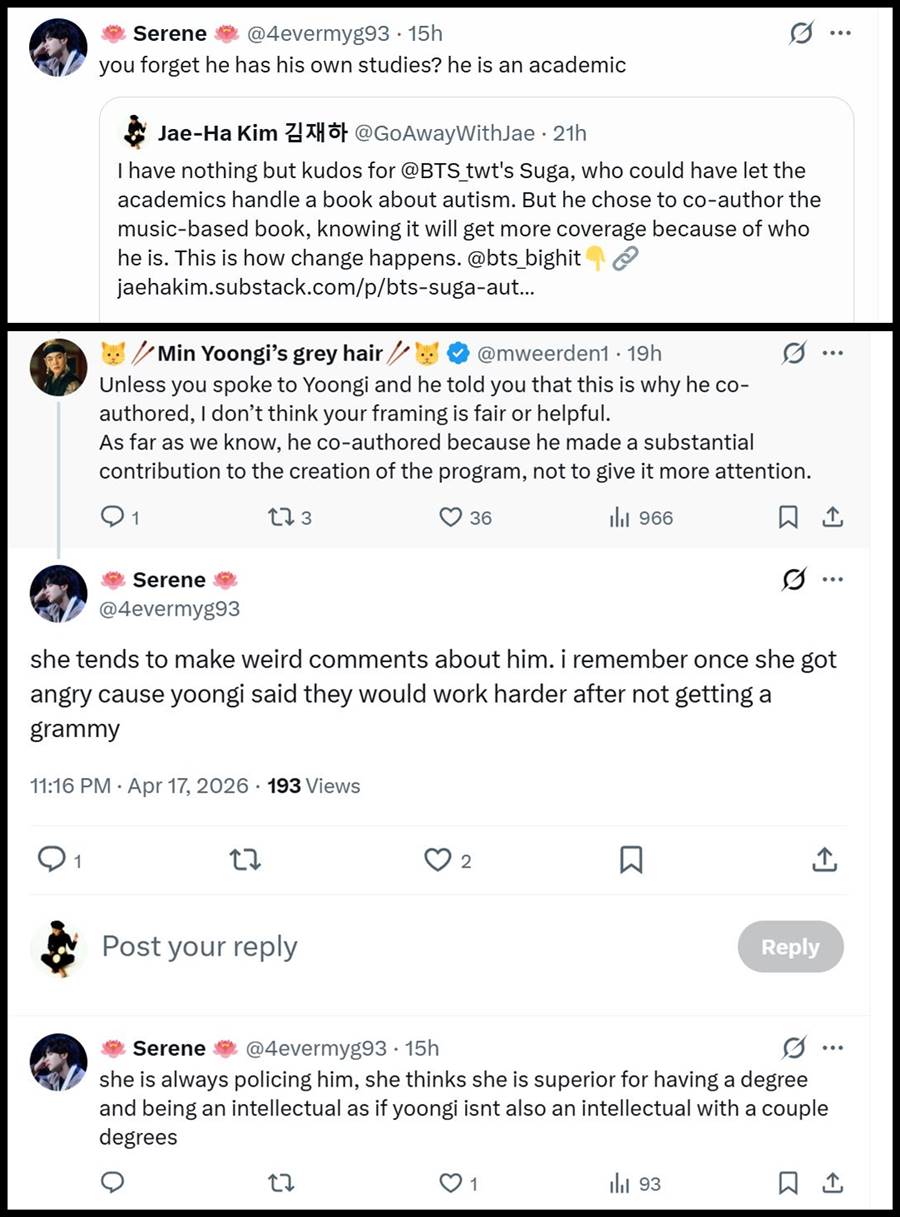
Too many of your readers are insufferable. That one bragging that she’s a psychologist and yet doesn’t know the meaning of the words academic and academia is embarrassing – for her, I mean. Thanks for writing about Yoon-gi and his book though. I’m not sure if my Korean is good enough to understand the book, but I’d like to give it a shot.