Losing My Korean Didn’t Make Me Any More American

Back in my era, the teachers encouraged immigrants to only speak English at home so that we wouldn’t fall behind. But what they didn’t know at the time — or perhaps they didn’t really care about — was that in the rush to make us understand English, many of us lost our ability to converse in our birth language.


“Suga: Road to D-Day”

“It’s my dream to travel around the world and play with local musicians playing their traditional instruments,” Suga says in his documentary Suga: Road to D-Day. “It’s my dream to record them and make music based on that.” But he has trepidation, too. “I worry that I won’t have anything to talk about,” Suga says. “I have fears that I have no more dreams to follow.”

“j-hope IN THE BOX”

“j-hope IN THE BOX” is told in a non linear way, starting in Seoul 52 days before j-hope’s performance at Lollapalooza, where he made history as the festival’s first Korean headliner — a feat that even he found surprising. The lead up to the concert — which fans dubbed Hobipalooza — depicts the pain the rapper took to ensure that his debut as BTS’ first solo artist would be nothing short of perfection.

How “Broker” and “Return to Seoul” reveal hard truths about Korean adoption

In an unusual cinematic coincidence, two critically acclaimed films about South Korean adoption were released in December depicting different sides of the adoption story. Broker focuses on a teenage girl who leaves her infant at a church’s safe haven baby box, while Return to Seoul tells the story of a French woman who reunites with her birth family just days after arriving in Korea. To better understand how these films speak to real-life adoptees, I talked to Korean academics, human rights experts, and adoptees. My reported piece for MASHABLE.

Don’t believe the K-dramas: Look to “Return to Seoul” for a more realistic view on Korean adoptees

In the superb “Return to Seoul” – which is Cambodia’s Oscar entry for the Best International Film category – French Cambodian filmmaker Davy Chou (“Golden Slumbers”) takes a look at what it means to be an adoptee who unexpectedly is reunited with her birth parents.

“The Dude in Me” (내안의 그놈)

“The Dude In Me” is a 2019 Korean fantasy film that centers on a high-ranking gangster and a high school student. When the latter accidentally falls from his school roof, he lands on the mobster. While neither dies, the mishap somehow switches the pair’s bodies and minds. Now, wiseguy Pan-soo is trapped in the body of chubby and bullied teenager Dong-hyun, while Dong-hyun is stuck in Pan-soo’s comatose body.

A Brief History of K-cinema

For many Westerners, Korean cinema didn’t enter their consciousness until the unparalleled success of the film “Parasite: in 2019. The gripping film deals with socio-economic discrepancies specific to modern-day South Korea, but the clever and sometimes brutal storyline hit a nerve with filmgoers worldwide. The film won the Palme d’Or at the Cannes Film Festival, an Oscar for Best Picture at the Academy Awards, and a BAFTA for Best Film Not in the English Language at the British Academy of Film and Television Arts.

“Seoul Vibe” (서울대작전)

“Seoul Vibe” is full of backstabbing, murder and mayhem. Director Moon Hyun-sung does a commendable job at keeping the plot moving, but he knows that the wild car chases are the key to this movie. 

“Emergency Declaration” (비상선언)

In the span of time it takes for a plane to fly from Seoul to Honolulu — approximately nine hours — a psychopath boards an airplane at Incheon International Airport and releases a deadly biological pathogen onboard, which results in passengers getting sick and/or dying (and turning on each other). And, oh yeah, scientists on the ground  develop an antigen to combat the virus.

“Juror 8” (배심원들)

In 2008, South Korea held its first ever trial by jury in Dageu. In that trial, jurors deliberated for two hours before deciding that the 27-year-old man accused of robbing and assaulting a 70-year-old woman in her home was guilty. “Juror 8” is not a fictionalized version of those events. Rather, it’s a story about a man who plead guilty to murdering his mother and the first Korean jury that will determine his sentence. 

“Hard Hit” (발신제한)

Seung-Gyu is an upper middle class bank manager who’s driving his children to school. While the kids bicker in the backseat, he answers a phone he doesn’t recognize. At first, he assumes it’s his wife’s phone and that the caller is trolling. But when the calls don’t stop, he worries about the what ifs. What if the caller isn’t lying? What if a bomb really will explode if he gets out of his car? What if?

“Silenced” (도가니)

Based on Gong Ji-young’s 2009 novel, “Silenced” is a brutal look at the systematic torture of children at a facility for the hearing impaired. Though Gong’s book is fictional, the stories she tells are based on the decades of real-life abuse that handicapped students endured at the Gwangju Inhwa School for the Deaf.

“The Way Home” (집으로)

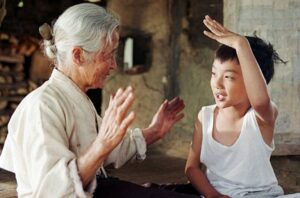
“The Way Home” is a bittersweet film about a young Seoul boy who is forced to spend the summer with his grandmother, who lives in the countryside. It’s not a quaint rural area that rich folks like to vacation in. Rather, it’s a small village where the bus comes on a irregular schedule and an angry cow chases little children.