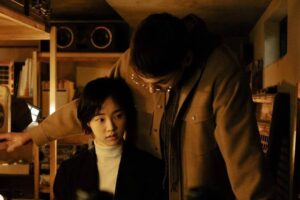
“Unlocked” (스마트폰을 떨어뜨렸을 뿐인데)

“Unlocked” came out a few months after the Korean series “Somebody.” Both revolve around cunning, good-looking serial killers who utilize technology to hack their way into their victims’ lives. In this 2022 film, the cell phone is the device of choice.

“Jinny’s Kitchen” (서진이네)

The concept? A group of telegenic Korean celebrities run a snack bar in Bacalar, Mexico, for one week (haha!). In its own way, it had all the elements of a fun K-drama minus any love triangles. Was there a 2nd male lead? Of course! As well as a 3rd and a 4th and so on. It shifted every few minutes, depending on who’s on screen — Park Seo-joon of “Itaewon Class,” “Parasite” actor Choi Woo-shik, BTS vocalist V, and the dimpled head of Jinny’s Kitchen, Lee Seo-jin (“Behind Every Star”).

“Summer Strike” (아무것도 하고 싶지 않아)

“Summer Strike” is one of those series that I started started, was meh about, and then returned to a few months later and found myself binging the rest of the show. The premiere episode was strong, focusing on a young office worker whose good nature is taken advantage of both at work and in her long-term relationship with a man who breaks up with her.

Losing My Korean Didn’t Make Me Any More American

Back in my era, the teachers encouraged immigrants to only speak English at home so that we wouldn’t fall behind. But what they didn’t know at the time — or perhaps they didn’t really care about — was that in the rush to make us understand English, many of us lost our ability to converse in our birth language.

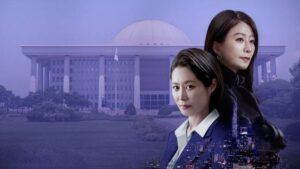
“Queenmaker” (퀸메이커)

One of the best K-dramas of the year, “Queenmaker” is the latest female-centric series led by women in their 40s (and older) that in nail-bitingly good. A political thriller with twists and turns, two foes unite to take down a corrupt chaebol family that will stop at nothing to protect their financial and familial interests.

“Divorce Attorney Shin” (신성한, 이혼)

At the center of this series is a trio of middle-aged male friends. Sung-han (Cho Seung-woo) is a classical pianist turned divorce attorney. Kim Sung-kyun plays his best friend Hyung-geun, who is reticent to give his wife — who is already pregnant with her new partner’s baby — a divorce. And Jeong-sik (Jung Moon-sung) runs a real estate business in a building owned by Sung-han.

“Suga: Road to D-Day”

“It’s my dream to travel around the world and play with local musicians playing their traditional instruments,” Suga says in his documentary Suga: Road to D-Day. “It’s my dream to record them and make music based on that.” But he has trepidation, too. “I worry that I won’t have anything to talk about,” Suga says. “I have fears that I have no more dreams to follow.”

K-Drama Star Park Ji-hu Talks “All of Us Are Dead,” NewJeans, and Crafting Empathy for Her Characters

“Little Women” actress Park Ji-hu consistently brings a sense of gravitas to her performances, embodying the youthful characters she portrays in a nuanced and truthful way. Here’s my cover story on the 19-year-old South Korean actress for Teen Vogue.

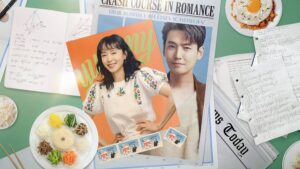
“Crash Course in Romance” (일타 스캔들)

“Crash Course in Romance” is about an elite hagwon math tutor who is so popular that mothers line up at all hours to get their children seats at his lectures. By chance, he encounters a former national handball player who gave up her dreams of competing on an international level to care for her niece, who was abandoned by her mother.

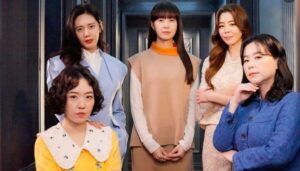
“Green Mothers’ Club” (그린마더스클럽)

The “Green Mothers’ Club” revolves around a group of moms whose lives are spent pushing their young children to academic excess. They spend money they don’t have on after-school hagwons for extra tutoring. And they clique together and take turns turning on whichever mom has been deemed the weakest for that week. Ultimately, the young lives they’re trying to elevate are the ones who suffer.

“Payback” (법쩐)

The early episodes of “Payback” held promise for a truly compelling thriller with the always great Lee Sun-kyung in the lead role. Lee plays Eung Yong, an ambitious man with a photographic memory when it comes to numbers. But the storylines get progressively more convoluted as the show progresses.

“Physical: 100” (피지컬: 100)

“Physical: 100” is riding high on the assumption that this athletic reality series is the real-life version of “Squid Game.” But as everyone knows by now, reality is a concept used to sell unscripted shows that are at least partially scripted to tell a certain story. Is this series fun to watch? At times. Is it novel? Not really. Anyone who remembers “American Gladiators” will recognize the cheese factor that drives these programs.

“j-hope IN THE BOX”

“j-hope IN THE BOX” is told in a non linear way, starting in Seoul 52 days before j-hope’s performance at Lollapalooza, where he made history as the festival’s first Korean headliner — a feat that even he found surprising. The lead up to the concert — which fans dubbed Hobipalooza — depicts the pain the rapper took to ensure that his debut as BTS’ first solo artist would be nothing short of perfection.

How “Broker” and “Return to Seoul” reveal hard truths about Korean adoption

In an unusual cinematic coincidence, two critically acclaimed films about South Korean adoption were released in December depicting different sides of the adoption story. Broker focuses on a teenage girl who leaves her infant at a church’s safe haven baby box, while Return to Seoul tells the story of a French woman who reunites with her birth family just days after arriving in Korea. To better understand how these films speak to real-life adoptees, I talked to Korean academics, human rights experts, and adoptees. My reported piece for MASHABLE.

“Tale of the Nine Tailed” (구미호뎐)

In Korean folk-lore, 구미호 — which literally translates into nine-tailed foxes — are cunning creatures who live to be about 100. As they age, they grow an extra tail. 구미호 are usually young women who seduce men to eat their livers or hearts. But in the K-drama “Tale of the Nine Tailed,” the alpha fox is Lee Yeon. Once the mountain God of Baekdudaegan, he was kicked out for a variety of reasons that revolved around his love for a human woman named Ah-eum.

“The Interest of Love” (사랑의 이해)

답답해. That’s the first feeling that comes to mind when I think of the K-drama “The Interest of Love.” The entire series is about a group of broken people who can’t articulate how they feel and are in a constant state of unhappiness because of this.