By Jae-Ha Kim
Substack (.pdf)
December 24, 2025
☆☆☆ (out of ☆☆☆☆)
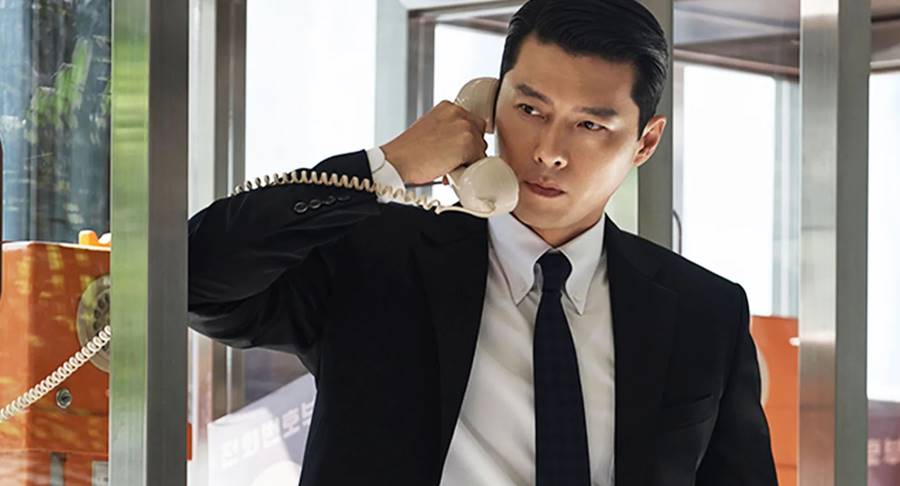
Baek Ki-tae (played by Hyun Bin)
Jang Geon-young (played by Jung Woo-sung)
↑Note: Korean names denote the surname followed by the given name.
Made In Korea was one of my favorite K-dramas of 2025 and was included in my annual list in Teen Vogue:
Hyun Bin (Crash Landing on You) stars in this political thriller set in the 1970s, a time when South Korea was still reeling from the immediate aftermath of the Korean War. Baek Ki-tae (Bin) is an influential member of the KCIA, which is described in the first episode as a dirty arm of the president’s office. Initially, it’s not clear if Baek is a hero working undercover, or if he’s as corrupt as the drug dealers he’s chasing. His nemesis is a tireless prosecutor (Jung Woo-sung) whose goal is to uncover Baek’s secrets.
Made in Korea doesn’t flinch in its portrayal of corruption by both the Korean government and its strongest ally, the U.S. military. Director Woo Min-ho presents a Korea where there are no heroes, but rather desperate survivors caught in the crosshairs. The series is shot in a film noir style over six-episodes, which will premiere on Dec. 24. This K-drama has already been picked up for its second season. (Hulu)
There is a lot going on in this six-episode series, but I want to unpack a few elements, that have historical significance. Please note that this review has spoilers.
Favorite episode
The first, which takes viewers back to the 1970s — an almost unrecognizable era when flying was a treat that passengers dressed up for. Most of the episode takes place on a commercial aircraft carrier full of Korean and Japanese passengers. The women have on dresses and the men wear suits with ties. Even the children are smartly dressed. The plane is filled with hazy smoke from cigarettes, which weren’t banned on flights. That’s the set up, before a nervous group of college revolutionaries hijack the plane and Hyun Bin’s Ki-tae uses his brains and brawn to deal with the situation. The hijackers’ goal is to live in the freedom of communist Cuba, but they end up settling for North Korea. (This scenario is based on a real-life event.)
We learn here that Ki-tae is Zainichi,1 which is brought up throughout the series. Despite speaking fluent Japanese and Korean, he isn’t spared from the kind of intersectional hatred each country has for the other, making him unwelcome for neither being fully Korean or Japanese.
Korea’s drug laws
South Korea has extraterritorial drug laws, meaning that not only is it illegal to take narcotics within Korea, but also overseas. For instance, if a Korean is caught2 smoking marijuana3 in a foreign country — even if recreational pot is legal there — they can be punished upon their return home.
Drugs play a huge role in Made in Korea, with warring factions from Korea and Japan battling each other for a bigger piece of the mayak (마약)4 market. It also is the driving force for one of the prosecutors, whose father is addicted to meth.
Methamphetamine and marijuana
One of the story arcs tackles a trio of drug-addicted American soldiers5 who murder a meth-dealing Korean couple. They are charged with three deaths, because the wife was pregant. Viewers may be surprised at the rampant drug use depicted within South Korea during the 1970s. Methamphetamine was first synthesized by a Japanese scientist in 1893 and later given to World War II soldiers in Japan and Germany to maintain their stamina. During the Korean War, the United States supplied soldiers with methamphetamine.
Smoking pot was on the rise among American soldiers. The Korean artistic community also indulged until 1976 when President Park Chung-hee instituted the Cannabis Control Act, criminalizing the smoking of marijuana. Did he really believe this act would make Korea a better country? Or was this his excuse to punish the artists who were calling out his dictatorship?
The Use of Languages
한국말 하세요?6 I understand why shows modernize language, but it takes me out of the element when an English loan word or a current slang (or portmanteau) is used during a period that it simply didn’t exist in Korea. In one scene, two attorneys go undercover, pretending to be a married couple. They refer to each other as jagiya (자기야) — the current Korean equivalent of honey or mine — which wasn’t a thing until maybe the 1990s. Back then, the common word spouses used was yeobo (여보).
And then a drug dealer used the word want to mean, well, want. (OK, I can give them a pass for including want, even though Koreans weren’t using it in Korea in the 1970s. But I was so annoyed when Lee Min-ho’s Han-su said want in Pachinko. No one said that in Korea in 1910!)
© 2025 JAE-HA KIM | All Rights Reserved
2 thoughts on ““Made in Korea””