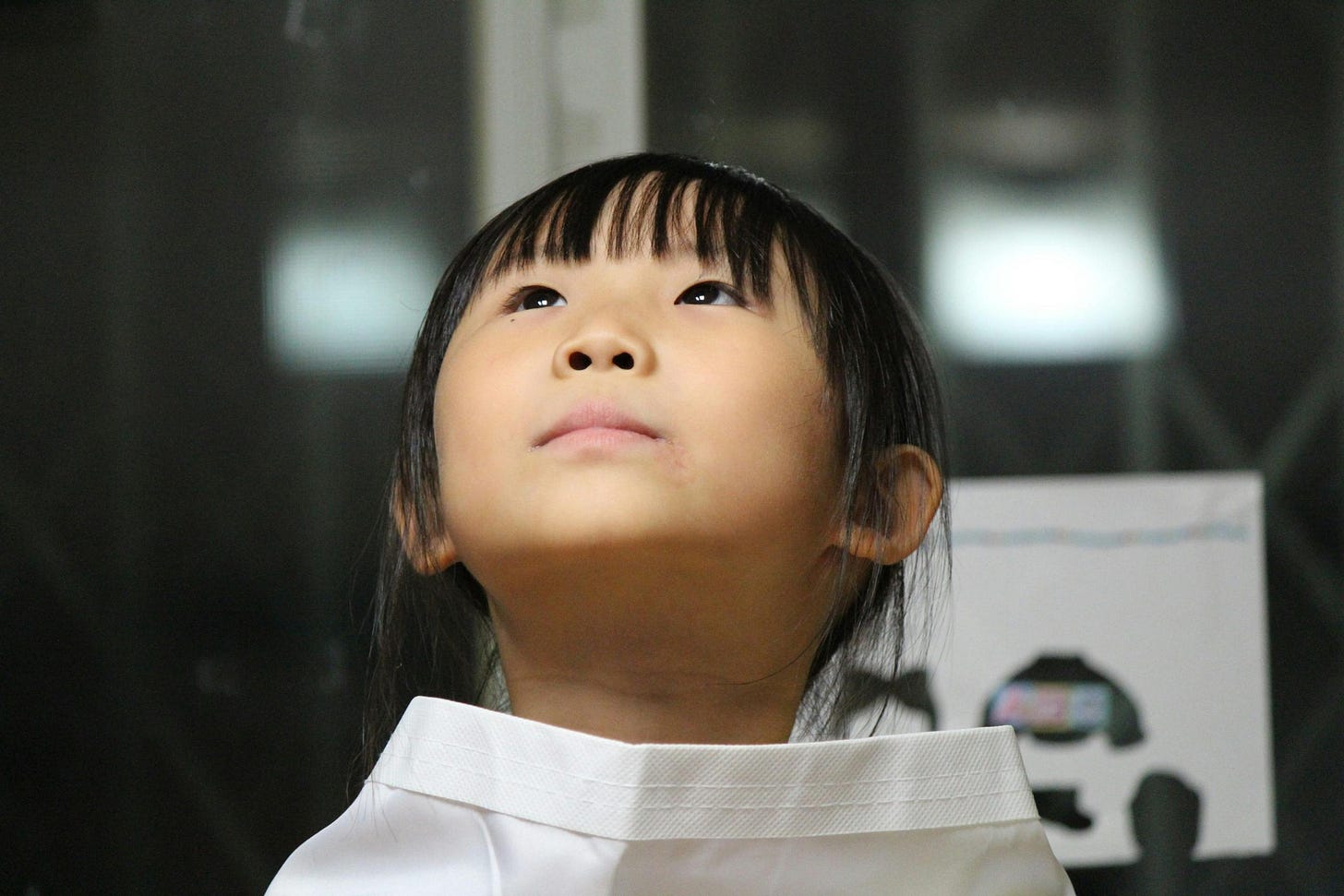
I have no idea if the little girl in the above photo is Asian American (or Asian diaspora). But if she is, I can almost guarantee that even at her young age, she has been questioned about her ethnicity and nationality (which some people can’t — or won’t — differentiate).
“Are you Chinese?”
“What are you?”
“Where are you from?”
“No, where are you really from?”
These are questions many of us Asian diaspora have been asked since we were tiny. In some cases, we actually are from a different country. For instance, I was born in South Korea, but I have lived in the U.S. for so long that you would never guess that I wasn’t a native English speaker.
Until you saw my face. At that point, some people start hearing a non-existent Asian accent, and they project foreignness on me. The thing is, while I am indeed an immigrant, there are millions of people who look like me, who were born in western countries. And so were their parents. And their grandparents. But they’re still treated like foreigners in their own country.
This is the perpetual foreigner syndrome at work, where we’re not viewed as real Americans. According to a study by the PEW Research Center, almost 80 percent of Asian Americans have experienced some kind of xenophobia and racism in their lives — ranging from assumptions that we don’t speak English to being told to go back to where you came from … even if we are already there.

Posts like this (on Threads) drive me a little mad, because I know what will come next. I want to comment, but I also don’t want to deal with the stop-being-so-sensitive contingent, who inevitably chime in about a topic they don’t understand and can’t relate to. But they still want to get the last word in and tell us how we should feel.
Case in point, this post by a woman who went out to dinner with her daughter went viral.

Many of the comments were like this dude’s, telling the original poster that she should’ve appeased the stranger who was butting into her evening out with her daughter. (FWIW, even if she was alone, she didn’t owe him small talk.)
Did none of these men think it was strange that this older man was rattling off thank you to her in different Asian languages? What was the point of that? Did he want to be rewarded for that? Couldn’t he have just been a normal human being and asked:
“Are you by any chance Japanese? Because my son-in-law is Japanese…”
”I just got back from Japan and thought it was such a beautiful country…”
She may not have wanted to engage in that conversation either, but what did he think he was accomplishing? Who does that? Was he interested in her? Did he want to show off his “awesome” language skills?

An.dy makes no sense. I’m not sure why the other diner’s behavior is acceptable because they’re in a Korean restaurant. Would it be acceptable in a French bistro? How about at a McDonald’s?
In his second comment, An.dy thought he was doing something, comparing Korea with America. But what An.dy forgets (or is unaware of) is that 99 percent of the population in South Korea is ethnically Korean. If they are guessing that you are a foreigner, there’s a distinct possibility that they could be correct.
That is clearly not th e case in the U.S., a country literally made up of immigrants.
[I discuss this more in my second post below.]

Let’s pretend that I’m older than Colleen and we’re in Korea. What would her reaction be if I started lobbing out-of-context words to her? Merci! Dzięki! Tack! And then when she makes it clear she doesn’t want to talk to me, I ignore her discomfort and continue. Hey, how much do you weigh? What is your income? How old are you? Those are all acceptable questions in Korea. (Do I approve of them? No, but when in Seoul…)
There is a contingent of people who say that Asian Americans who don’t like being asked where are you really from? are overly sensitive, that the people questioning who or what we are mean well and we should politely reply back to them.
They will point out they have an Asian friend who likes being asked questions about their heritage, even when their heritage is Iowa.
Well, that’s delightful for them.
But when the majority of Asian diaspora are literally telling you that we don’t like it, consider listening to us instead of telling us how we should feel.

Some of my white acquaintances have gotten salty when I talked about my experiences of being othered. They said that they know exactly how I feel, because they are sometimes treated poorly because they have foreign accents.
The difference, I told them, is that strangers don’t assume they are immigrants based on their appearance. If you look the way I do, that’s the first thing that they assume. Which is why I get called a chink — even though I speak perfect English — and they don’t get called called [fill in the slur for white Europeans], because white is the default for an American in the U.S.
White immigrants are accepted as Americans. Meanwhile, Asians born in the U.S. are still asked what country they’re from.

Every now and then, this post from Twitter shows up and always makes me laugh. I have no idea if this really happened. But based on my own experiences, it’s close to reality for too many of us.

[If you want to read more about this topic, keep reading! Below, I’m sharing an essay I wrote in 2018. A New York Times reporter referred to a figure skater as an immigrant. Mirai Nagasu was born in the United States. It’s disappointing to think that in the past seven years, so little has changed.]
© 2025 JAE-HA KIM | All Rights Reserved